
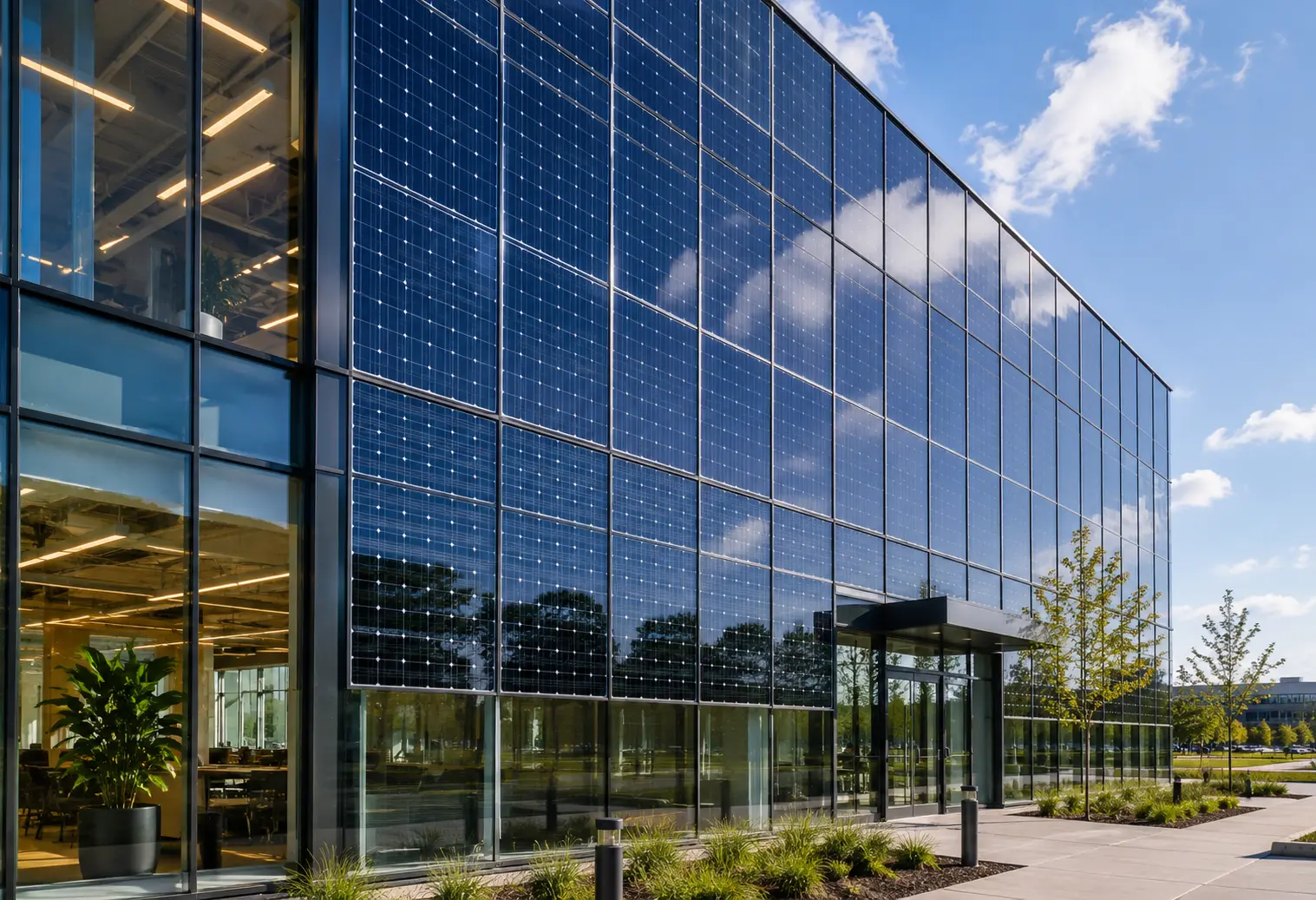
Saint-Gobain Glass has launched COOL-LITE SKN 155 and SKN 155 II, the next-generation replacement for the widely specified SKN 154 line. The new double-silver solar control coating brings refined aesthetics, 50% light transmission with a 27% g-value, and availability on the ORAÉ low-carbon substrate—giving spec writers a drop-in path to lower embodied carbon without retooling façade design.
Saint-Gobain Glass has expanded its COOL-LITE family with the launch of COOL-LITE SKN 155 and SKN 155 II, a next-generation double-silver solar control coating engineered for high-performance façades. The announcement, dated June 4, 2026, is more than a routine product refresh: it signals the gradual phase-out of the widely specified SKN 154 line across Europe and gives architects a path to refined aesthetics and lower embodied carbon without rewriting their façade details.
For specifiers who have leaned on the SKN 154 family for offices, hospitals, schools, and curtain wall applications, the practical question is straightforward—how does the new generation perform, and what does the transition mean for projects already in design?
What's New in SKN 155
The core technical story is incremental but meaningful. Built on double-silver coating technology, COOL-LITE SKN 155 and SKN 155 II deliver 50% light transmission and a solar factor (g-value) of 27% in standard configuration. That balance is designed to keep interiors bright while limiting solar heat gains, supporting reduced cooling demand—a critical performance lever as European energy codes continue to tighten.
The new generation also brings a refined, neutral aesthetic. Saint-Gobain emphasizes low external reflection and a consistent appearance at any viewing angle, which matters for large-format curtain walls and unitized façades where coating uniformity across thousands of square meters is a known specification headache.
For processors and fabricators, the key technical parameters to note:
- Annealed and to-be-tempered versions are both available, preserving the flexibility that made the SKN 154 line a workhorse for façade contractors.
- Substrate options include PLANICLEAR, DIAMANT, and—critically—ORAÉ low-carbon glass.
- Selectivity remains in the double-silver SKN range, which Saint-Gobain rates up to 2.0.
The Low-Carbon Substrate Angle
The ORAÉ availability is arguably the most strategically important detail in this launch. Saint-Gobain's selective solar control product families COOL-LITE XTREME and COOL-LITE SKN are available on ORAÉ, the company's low-carbon flat glass substrate. For projects pursuing LEED v5, EU Taxonomy alignment, or owner-driven embodied carbon targets, this means a high-performance solar control specification no longer forces a tradeoff between operational performance and the upfront carbon number that appears on an EPD.
This matters because solar control coatings are typically specified for façade-dominated commercial buildings—the same projects where embodied carbon scrutiny has intensified. Pairing a 50/27 LT/g-value profile with a lower-carbon substrate is the kind of combination that lets project teams hit both operational energy and embodied carbon targets in a single product line.
What This Means for Spec Writers
SKN 155 is positioned as the successor to SKN 154 across Europe, with a managed transition planned to ensure continuity for existing specifications. For architects with active projects:
- Projects in design phase should confirm with their Saint-Gobain rep which version will be available at the project's procurement window. Substituting SKN 155 for SKN 154 should be a relatively clean swap given the comparable performance envelope, but visual mockups for facade-driven projects are still worth requesting given the aesthetic refresh.
- Projects already specified with SKN 154 are not immediately at risk—the phase-out is described as gradual—but anyone writing new specs in 2026 should likely move directly to SKN 155.
- U.S. specifiers should note this is a European generation launch. North American availability and SHGC values (measured under NFRC rather than EN 410) will likely follow on a different timeline.
The Bigger Competitive Picture
The SKN 155 release lands in a market where solar control selectivity is becoming a competitive battleground. Saint-Gobain's own triple-silver COOL-LITE XTREME line pushes selectivity above 2.0 with neutral aesthetics, while competitors continue to release coatings targeting similar 50/27-class performance. The differentiator is increasingly the combination of coating performance, low-carbon substrate availability, and aesthetic consistency across viewing angles.
For building product manufacturers downstream—IGU fabricators, curtain wall extruders, and unitized façade assemblers—the practical implication is straightforward: validate SKN 155 in your existing build packages, confirm tempering and lamination protocols match the new coating, and update your spec libraries before the SKN 154 phase-out catches procurement teams off guard.