
Oldcastle BuildingEnvelope's new Reliance-TC SS marries screw-spline fabrication economics with thin triple IGUs to deliver curtain wall U-factors as low as 0.19—without growing system depth. Here's what it means for stretch-code compliance and glazier shop workflow.
A Screw-Spline System Built for Stretch Codes
Oldcastle BuildingEnvelope (OBE) has launched Reliance-TC SS (Thermal Control Screw Spline), a new high-thermal curtain wall built on the company's existing Reliance platform. The headline number is unusual for a screw-spline product: the system achieves U-factors as low as 0.19 using thin triple insulating glass units (IGUs) without increasing overall system depth, and meets the demanding code requirements in IECC Climate Zones 4-8, as well as evolving stretch codes.
That combination—a familiar field-assembled curtain wall with passive-house-adjacent thermal performance—lands at a useful moment. Stretch energy codes in states like Massachusetts, New York, California, and Washington are pushing prescriptive U-factor targets that conventional thermally broken aluminum curtain walls struggle to hit without going to deeper mullions, exterior insulation overlays, or unitized construction.
Why Screw-Spline Still Matters
Unitized curtain wall dominates the conversation on large commercial towers, but a huge share of mid-rise commercial, institutional, and healthcare work still gets glazed with screw-spline systems. The reasons are economic: lower tooling investment, smaller shop footprints, and the ability for regional glaziers to fabricate without a unitized assembly line.
The new Reliance-TC SS high-thermal screw-spline curtain wall from Oldcastle BuildingEnvelope combines advanced thermal performance with fabrication efficiency and facade flexibility, supporting the evolving performance needs of today's building projects. According to OBE, the system is built on a screw-spline assembly, helping streamline shop fabrication and support efficient field installation using familiar methods.
Translation for contract glaziers: the labor and tooling assumptions baked into your existing Reliance estimates should largely carry over, while the spec sheet now answers the energy code question.
The Thin Triple Story
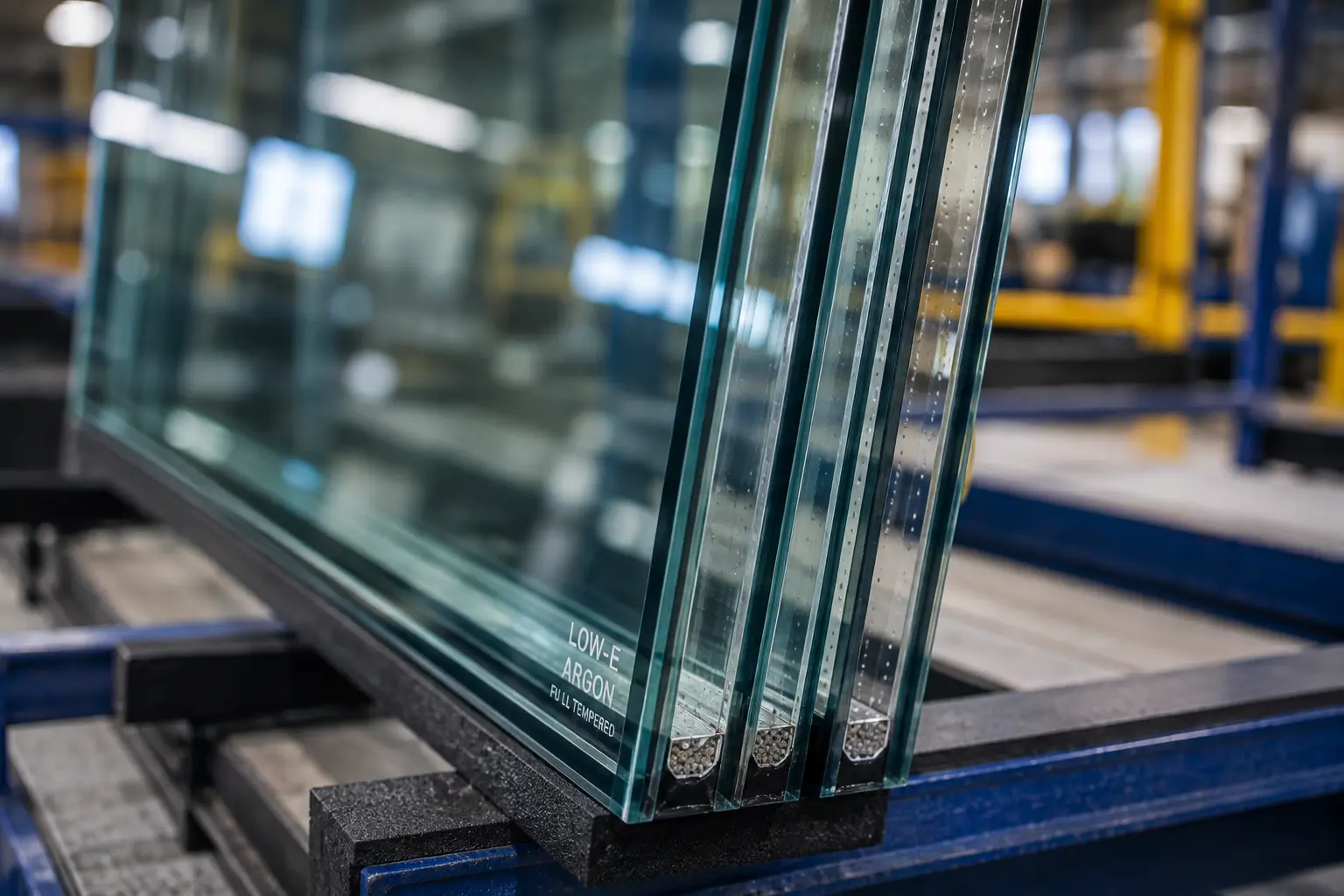
The path to U-0.19 isn't a deeper pocket or a heavier extrusion—it's the IGU. Thin triple IGUs use a 1mm or thinner center lite (typically chemically strengthened) suspended between two conventional lites, with two low-conductance gas-filled cavities. The result is triple-pane thermal performance in an overall thickness close to a standard 1-inch IGU.
That geometric compatibility is what lets OBE keep system depth constant. Specifiers and detailers should note the practical implications:
- Sightlines and shadow boxes designed around the current Reliance depth don't need to be reworked
- Perimeter conditions—head, sill, and jamb interfaces with adjacent assemblies—stay coordinated
- Anchorage and embed schedules developed for Reliance loading can largely be reused, subject to dead-load review for the heavier IGU
- Spandrel and vision transitions maintain the same module logic
What Spec Writers Should Update
For architects working on projects in IECC Climate Zones 4-8 or jurisdictions with stretch codes (Mass Stretch, NYStretch, California Title 24, Seattle Energy Code), Reliance-TC SS gives a Division 08 41 13 option that can be specified without forcing a unitized procurement strategy.
Things to confirm during specification:
- Tested vs. modeled U-factor: U-0.19 is presented as a system capability with thin triple IGUs—confirm the specific IGU configuration, frame size assumptions, and NFRC documentation against your project's compliance path
- Condensation Resistance (CR): Thin triples typically improve interior surface temperatures, but verify CR values for high-humidity occupancies
- Solar Heat Gain Coefficient (SHGC): Make sure the triple IGU coating package still hits your SHGC target after the added substrate
- Acoustic performance: Thin triples behave differently than mass-loaded laminated IGUs for STC/OITC—worth a separate spec line if acoustics matter
The Bigger Trend
This launch follows a broader market shift toward ultra-thermal curtain wall systems and the mainstreaming of thin triple IGUs. OBE positions itself as North America's leading vertically integrated manufacturer, fabricator, and distributor of architectural hardware, glass, and glazing systems, with a portfolio that includes CRL and Graham Architectural Products.
With OBE's distribution reach, expect Reliance-TC SS to show up quickly in early-stage spec packages—particularly on K-12, higher education, and healthcare projects in cold climates where the U-factor delta to a conventional curtain wall can be the difference between code compliance and a costly redesign.