Safti First's new Environmental Product Declaration for its SuperLite II-XL fire-resistive glass family closes a persistent data gap for specifiers chasing LEED, Buy Clean, and IgCC embodied carbon targets. Here's why the disclosure matters for anyone specifying rated openings, curtain walls, or floors.
A category that's been missing from the embodied carbon conversation
Spec writers chasing LEED v4.1 Materials & Resources credits, IgCC compliance, or state-level Buy Clean thresholds have gotten used to pulling Environmental Product Declarations (EPDs) for float glass, aluminum framing, insulating glass units, and even sealants. Fire-resistive glazing has been the stubborn exception. That's changing.
Safti First announced the publication of an independently verified Environmental Product Declaration for its SuperLite II-XL fire resistive glass product family. The disclosure was published through Smart EPD and developed in accordance with ISO 14025 and ISO 21930:2017—the two standards that give an EPD legitimacy on a CSI-formatted submittal.
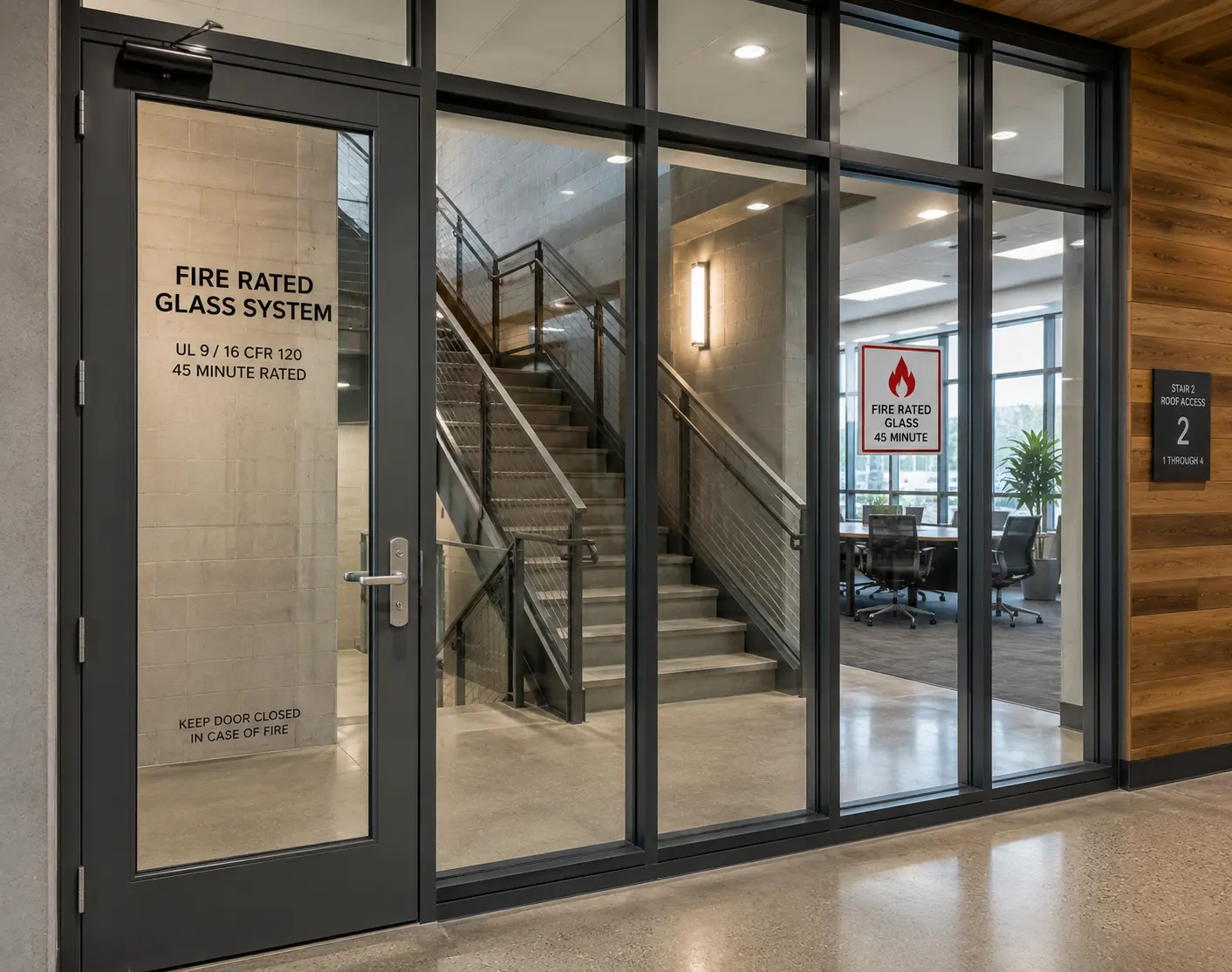
SuperLite II-XL is a workhorse in the fire-resistive glazing category. It's the multi-laminate, tempered assembly that lets architects hit 60- to 120-minute ratings under ASTM E119 / UL 263 in walls, doors, transoms, storefronts, and floor assemblies where blocking radiant heat—not just flames and smoke—is a code requirement. Until now, the embodied carbon of that assembly was largely a black box on the sustainability line of the spec.
What the new EPD actually covers
The declaration is a cradle-to-gate assessment, which is the standard scope for architectural glass EPDs and the format most life-cycle assessment (LCA) tools expect. It covers three lifecycle stages:
- A1 – Raw material supply
- A2 – Transportation of raw materials
- A3 – Manufacturing at Safti First's facility in Merced, California
The declaration reports environmental impact categories including Global Warming Potential (GWP), Ozone Depletion Potential (ODP), Acidification Potential (AP), Eutrophication Potential (EP), and Photochemical Ozone Creation Potential (POCP). Those five categories are exactly what Tally, One Click LCA, EC3, and Athena Impact Estimator ingest when a project team is modeling whole-building embodied carbon.
Bill O'Keeffe, president and owner of Safti First, framed the release as part of the company's continued commitment to product transparency and sustainable manufacturing.
Why fire-rated glazing has been an embodied carbon blind spot
Fire-resistive glass is materially very different from standard architectural float glass. A single lite of SuperLite II-XL can weigh three to four times as much as an equivalent-thickness IGU because it typically stacks multiple tempered lites with intumescent interlayers that expand and char when exposed to fire. That mass—and the specialized manufacturing behind it—translates to a meaningfully different embodied carbon signature per square foot than a standard low-E IGU.
Without a category-specific EPD, LCA modelers have had two bad options:
- Use a generic flat glass EPD and undercount the impact by ignoring the additional lites and interlayers.
- Assign a rough multiplier based on mass, which introduces significant uncertainty into the whole-building carbon total.
Neither approach holds up under Buy Clean audits or third-party LEED reviews. A product-specific, third-party-verified EPD ends that guesswork for the SuperLite II-XL family.
Practical implications for architects, GCs, and glazing contractors
For architects and spec writers. Section 08 44 00 (curtain wall) and Section 08 80 00 (glazing) spec language increasingly includes an EPD requirement tied to LEED v4.1 MR credits or state Buy Clean statutes. Firms specifying fire-rated assemblies in occupancy separations, exit stairs, atrium enclosures, or two-hour horizontal exits can now cite a specific product EPD instead of relying on an industry-average value—or worse, leaving the line item blank.
For glazing contractors and GCs. On projects with material transparency requirements (particularly public-sector work in California, Colorado, New York, and Oregon), the ability to submit a product-specific EPD at closeout is becoming a documentation deliverable, not just a preference. Having one in hand for the fire-resistive scope removes a common submittal headache.
For building product manufacturers. Safti First is establishing a precedent in a niche product category where competitors have not yet published product-specific EPDs. Expect other fire-rated glass and framing manufacturers—Pilkington, Vetrotech, TGP/Allegion, AGC Interpane—to follow within the next 12 to 18 months as architects begin to write "EPD required" into the fire-rated line items.
The bigger picture
Fire-rated openings have historically been treated as a code-driven line item—get the rating, move on. The new EPD signals that even the most specialized glazing categories are being pulled into the embodied carbon accounting that now shapes public-sector procurement and premium private-sector work. If your firm is still leaving fire-rated glazing out of the carbon model, that gap just got harder to justify.