Guardian Glass used a new BirdLife International documentary and the Maine Audubon Gilsland Farm visitor center to debut Bird1st Mirage, a visible-spectrum bird deterrent coating that eliminates the laminated interlayer typically required by UV-based alternatives. With launch targeted for 2027, specifiers have a new tool for Local Law 15, Threat Factor ≤25, and other bird-safe mandates.
A New Bird-Friendly Option Lands on the Specifier's Radar
Guardian Glass has given the industry its clearest look yet at Bird1st Mirage, the next addition to its bird-friendly portfolio, through the Gilsland Farm Audubon Center in Portland, Maine, and a short documentary produced with BirdLife International and Content With Purpose.
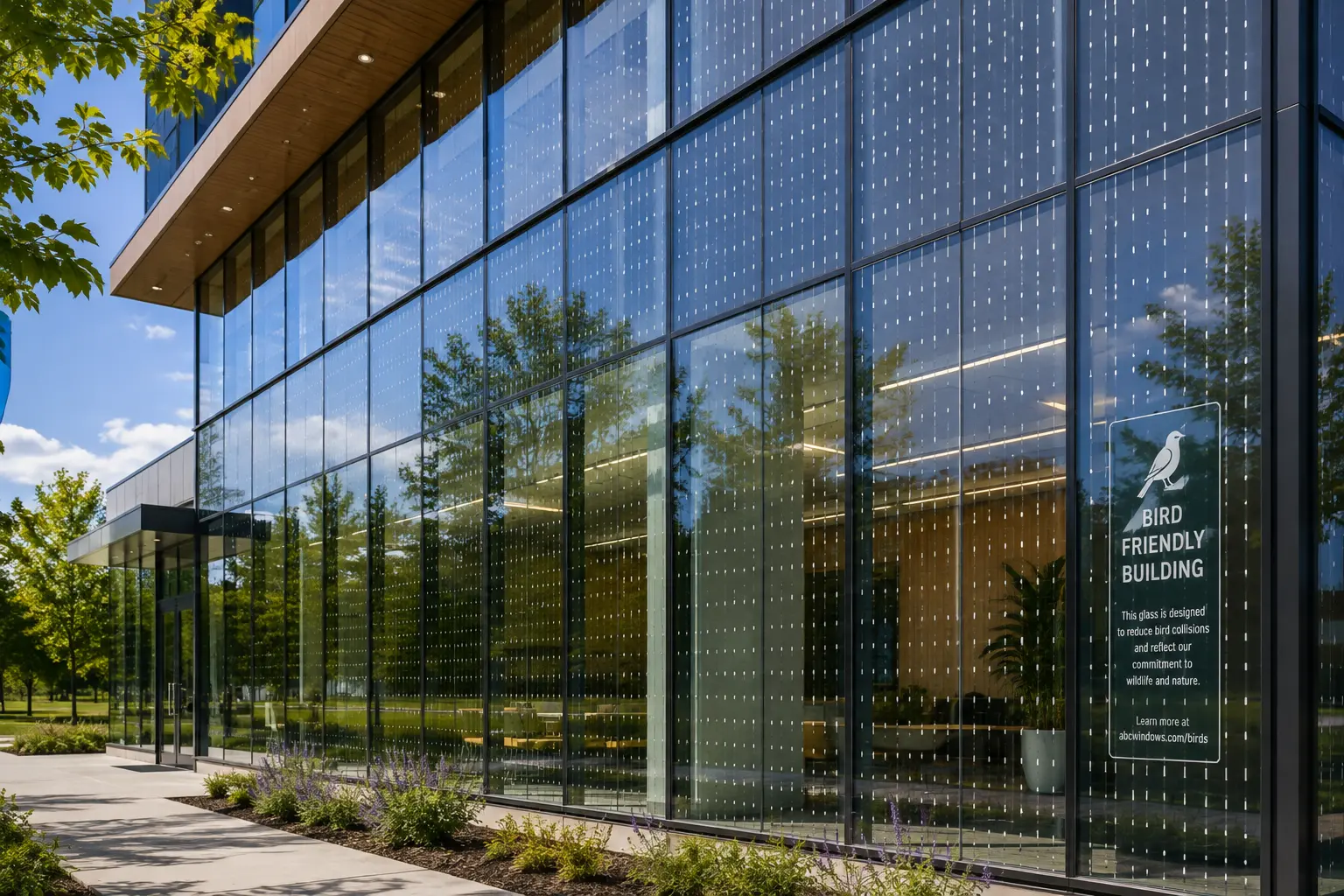
The Maine Audubon visitor center offers a first look at Bird1st Mirage, the next of Guardian Glass's bird-friendly glass solutions, with launch expected in 2027. Fabricator Thompson Innovative Glass and glazier Sierra Pacific Windows partnered with Guardian to complete the project.
The product rollout is being anchored by a video — an episode of Global Flyways, a documentary series that explores the challenges facing migratory birds, titled Designing Safer Skies, which examines how the built environment is working to help reduce bird-glass collisions.
What Makes Mirage Different From Existing Bird-Safe Glass
Most commercially available bird-friendly glazing falls into two buckets: external frit or ceramic patterns that birds and humans can both see, and UV-reflective coatings that largely disappear to building occupants but require careful fabrication. Mirage sits in a new middle category.
According to Guardian's own technical overview, Bird1st Mirage features a visible coating pattern applied to surface #1 that appears transparent when building occupants look from the inside out, and is expected to meet bird-friendly requirements in combination with selected Guardian SunGuard low-E coatings, offering a single solution that combines energy performance and bird deterrence.
Two specifics matter for specifiers and fabricators:
- No laminated interlayer required. Because the patterned coating is in the visible spectrum, there's no need for a laminated interlayer to absorb UV light. That removes a cost, weight, and lead-time driver that has frustrated bird-safe projects working with UV-only products.
- Fabrication flexibility at jumbo sizes. A non-directional pattern and anticipated jumbo and super jumbo dimensions will provide flexibility during fabrication and help optimize cutting yields. That's significant for curtain wall and storefront fabricators cutting from stock sheets.
- Minor light-transmission trade-off. The Mirage pattern is transparent and lowers brightness a little but retains an unobstructed view.
The Regulatory Backdrop Specifiers Can't Ignore
Mirage is arriving into a market where bird-safe glazing is no longer a boutique sustainability upgrade. It is becoming a code-driven requirement.
Guardian's current UV-based product line is already positioned against the key benchmarks: Bird1st UV complies with New York City's Local Law 15 and other U.S. regulations requiring a Threat Factor ≤25. That Threat Factor reference matters because Guardian Glass bird-friendly solutions are confirmed by acceptable Threat Factor scores from the American Bird Conservancy, where Threat Factor indicates the percent of times birds will not avoid collision, and ABC defines "bird-friendly" materials as having a Threat Factor ≤30.
The scale of the underlying problem continues to drive policy: up to one billion bird deaths in the United States are attributed to collisions with buildings and other structures each year.
Practical Implications for Architects, Glaziers, and GCs
For architects and specifiers. Mirage is worth flagging in design development packages now, even though it won't ship until 2027. If a project is targeting LEED Pilot Credit 55, NYC Local Law 15, Washington D.C.'s Migratory Local Wildlife Protection Act, or ordinances in Toronto, San Francisco, or Portland, Oregon, specifying teams should be asking Guardian reps for projected Threat Factor data and compatible SunGuard low-E pairings before locking in curtain wall details.
For glazing contractors and fabricators. The absence of a required laminated interlayer is the biggest change to watch. Many UV-based bird-safe assemblies push glaziers into laminated IGUs with specific orientation requirements. A surface-#1 coating on monolithic or standard IGU build-ups removes a significant handling and inventory complexity.
For general contractors. The Gilsland Farm project is a useful reference — a low-rise visitor center in a known migratory corridor — which lines up with the field evidence that the vast majority of fatal collisions happen at low-rise structures rather than towers. That shifts bird-safe glazing from a trophy-tower issue to an everyday multifamily, civic, education, and healthcare question.
What to Watch Next
Guardian has not yet published final Threat Factor scoring, pricing, or the full list of compatible SunGuard coatings for Mirage. Those are the data points specifiers will need before Mirage can move from narrative to spec sheet. Expect American Bird Conservancy validation and formal product data sheets in the run-up to the 2027 commercial launch — and expect competing float-glass producers to respond with surface-#1 visible-pattern products of their own.