
A new case study from the Geelen Counterflow headquarters in the Netherlands puts building-integrated photovoltaics on a large-format IGU that pushed a BREEAM NL score to 99.94%. For architects and facade consultants, the numbers matter more than the novelty.
A BIPV Case Study Worth Reading
The building-integrated photovoltaics (BIPV) market has spent a decade trying to shake its reputation as a niche technology bolted onto sustainability-showcase projects. A newly circulated case study from the Netherlands is worth attention because it moves the conversation from "can BIPV work in a real curtain wall" to "how large can a single unit get, and what does it enable on the scorecard."
At the Geelen Counterflow headquarters extension in Haelen, Netherlands, Onyx Solar Energy supplied photovoltaic glass laminated with EVALAM UC, a high-performance EVA encapsulant developed for photovoltaic and BIPV applications. The result is a BIPV façade on a building that has been recognized internationally for its sustainability performance.
The Numbers That Matter
The façade specification is unusual by BIPV standards:
- Panel size: Up to 3,829 × 1,994 mm — closer to a unitized curtain-wall lite than a traditional PV module
- Assembly: Double-glazed chamber with 12 mm argon fill, 60 mm total thickness
- Weight: 630 kg per unit — reportedly the heaviest photovoltaic glass Onyx Solar has manufactured to date
- Cell technology: Monocrystalline 5BB (five-busbar) crystalline silicon
Crystalline silicon remains the workhorse of BIPV façades, delivering roughly 20 watts per square foot with efficiency ratings in the 20–22% range for commercial modules. The Geelen project pushes that technology into a large-format IGU that reads architecturally as glazing, not as a solar panel bolted onto glazing.
Why the BREEAM Number Is the Real Headline
The Geelen Counterflow building holds a five-star BREEAM NL certification with a score of 99.94% — a figure that positions it among the most sustainable office buildings in the world. The extension was designed by Architecten en Bouwmeesters.
For spec writers, the practical takeaway is not that BIPV alone drove a 99.94% score. It's that BIPV was compatible with the entire envelope-and-energy strategy required to reach that number, without forcing the architect to compromise on daylighting, view, or facade rhythm. That's a different conversation than BIPV had five years ago, when the trade-off was usually reduced vision area or an obviously "solar" aesthetic.
The Encapsulant Story Is Quieter — and Important
The module lamination used EVALAM UC, which is engineered for structural support, electrical insulation, and high transparency in solar modules. Its thermal stability is designed to reduce shrinkage during lamination, and it offers strong adhesion, high light transmission, and compatibility with module components — all of which matter when you're laminating cells inside a 60 mm IGU that has to survive facade thermal cycling for decades.
Encapsulant selection is where a lot of early BIPV facades quietly failed: delamination, yellowing, and bubble formation degraded both the electrical output and the architectural aesthetic. A durable EVA formulation is now table stakes for a facade-grade BIPV unit.
Practical Implications for Specifiers
A few things architects, facade consultants, and envelope engineers should take from this project:
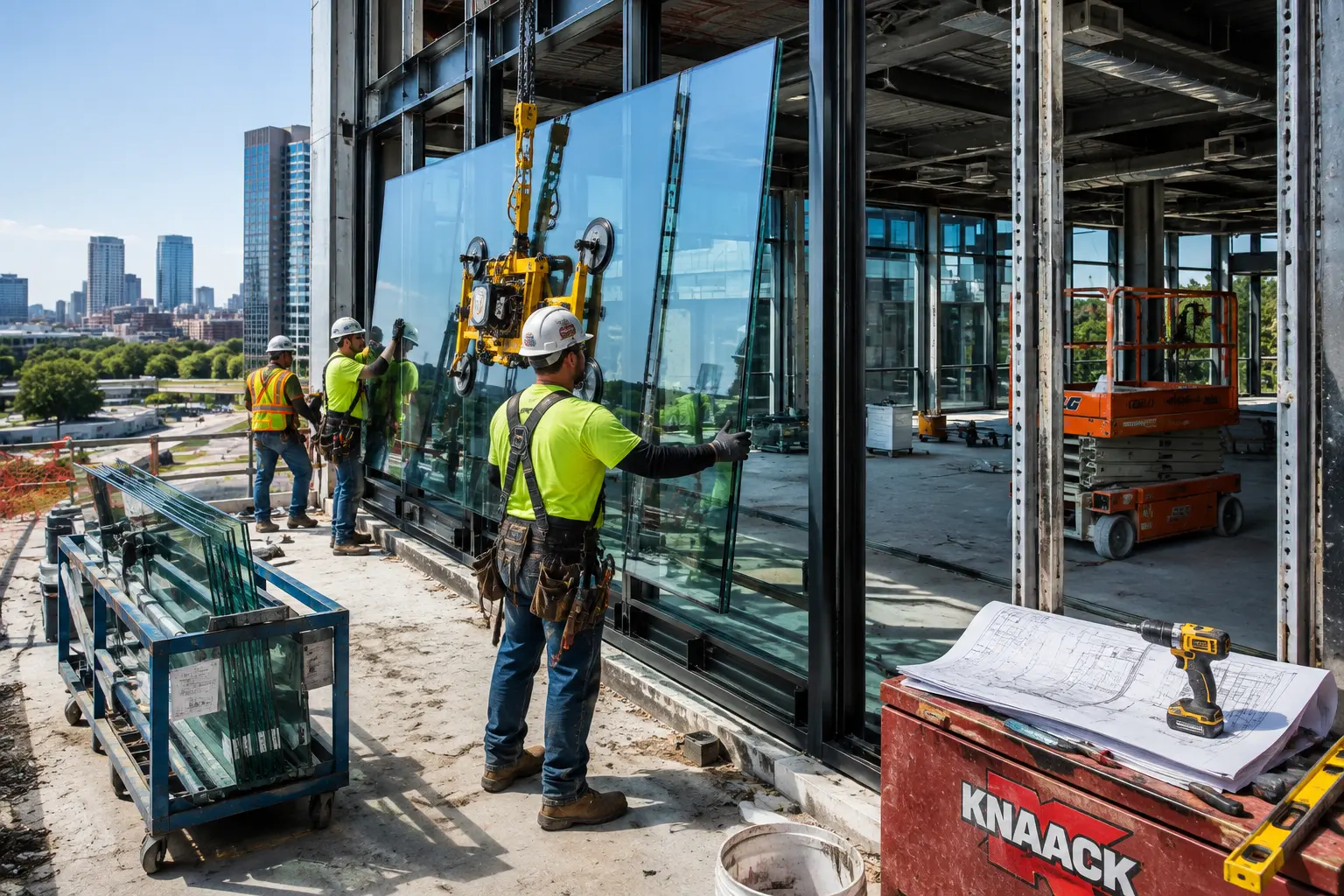
- Large-format is here. A single BIPV IGU at nearly 3.8 meters tall changes the calculus for unitized systems. It means BIPV can now respect a curtain-wall grid rather than dictating a smaller module rhythm.
- Weight is a structural conversation, not a deal-breaker. At 630 kg per unit, framing, anchors, and hoisting all need coordination — but the industry already handles similar loads for oversized IGUs and structural silicone glazed vision units.
- BIPV is now scoreable. With BREEAM, LEED, and increasingly stringent European Energy Performance of Buildings Directive (EPBD) requirements, on-site generation credit combined with a compliant thermal envelope is a real path to points. This project demonstrates the top of that curve.
- The supply chain is maturing. A project of this scale requires a PV glass manufacturer, an encapsulant supplier, an insulating glass fabricator, and a facade contractor working from compatible specifications. That coordination — not the cell technology — is the current bottleneck.
For North American specifiers watching the EPBD-driven pipeline, the Geelen precedent is a useful reference the next time an owner asks whether BIPV can carry a signature façade rather than a rooftop.