Saint-Gobain has cut the ribbon on a 15,000-square-foot fire testing laboratory at its Northborough Innovation Hub—the first of its kind on the continent for the building materials giant. For specifiers dealing with UL and ULC-rated wall, partition, and glazing assemblies, in-house testing signals faster iteration cycles and shorter paths to certification.
Saint-Gobain North America has quietly stood up one of the more consequential pieces of building envelope testing infrastructure to open on U.S. soil this year. The company announced the opening of a state-of-the-art fire testing lab at its newly branded Innovation Hub North America, spanning 26 acres across Northborough and Marlborough, Massachusetts. For a company whose portfolio spans gypsum, insulation, glass, and specialty façade materials, moving fire compliance testing in-house is a significant capability shift—and one with real downstream implications for architects and contractors specifying rated assemblies.
What Was Built
The facility is the company's first fire testing laboratory in North America, and it did not come cheap. The 15,000 square foot project, which broke ground in October 2024, represents a nearly $30 million investment in the region, and construction involved more than forty local trade partners and subcontractors. The lab sits on a campus that has been in the middle of what the company describes as a decade-long modernization push, now formally renamed from Saint-Gobain Research North America to Innovation Hub North America.
Critically for specifiers, the facility was designed to meet the industry leading ANSI/UL and CAN/ULC standards for measuring the fire resistance of construction materials, with the goal of earning the ability to offer essential product certification credentials. That's the two-country compliance envelope most commercial project teams in the U.S. and Canada actually care about—UL 263, ULC-S101, and the assembly-level tests that govern everything from shaft walls to fire-rated glazing framing.
Why In-House Fire Testing Matters
External fire testing is a well-known bottleneck. Third-party lab queues can run months, and every design change—whether a new gypsum core formulation, a revised intumescent, or a different mineral wool density—triggers another round of scheduling, shipping, and witnessing. Bringing this capability in-house enables Saint-Gobain to be more nimble in its R&D and innovation, offer customers solutions more quickly, and provide additional opportunities for collaboration and customization.
For architects and building envelope consultants, that speaks directly to two persistent pain points:
- Custom assembly approvals. Non-standard partition build-ups, unusual head-of-wall conditions, and hybrid glazing perimeters often require project-specific engineering judgments or one-off tests. Faster access to a manufacturer-owned furnace can compress that timeline.
- Product iteration speed. New sustainability targets (lower-embodied-carbon gypsum, bio-based insulation binders, reduced-PVB laminates near fire-rated openings) require re-testing. A dedicated in-house lab shortens the loop between R&D and a UL listing update.
The Sustainability Angle Is Not Cosmetic
Fire labs are dirty facilities. Burning full-scale wall assemblies produces smoke, particulates, and combustion byproducts that have historically constrained where these labs can operate. Saint-Gobain has leaned into that engineering challenge: the fire lab features one of the most advanced emissions control systems available, and will be used to safely and sustainably test Saint-Gobain's construction materials for compliance with fire certification standards.
That matters because it makes the facility defensible in a densely populated Massachusetts research corridor—and it signals to peer manufacturers that the next generation of on-site fire labs will need to clear a higher environmental bar to get permitted at all.
Strategic Positioning
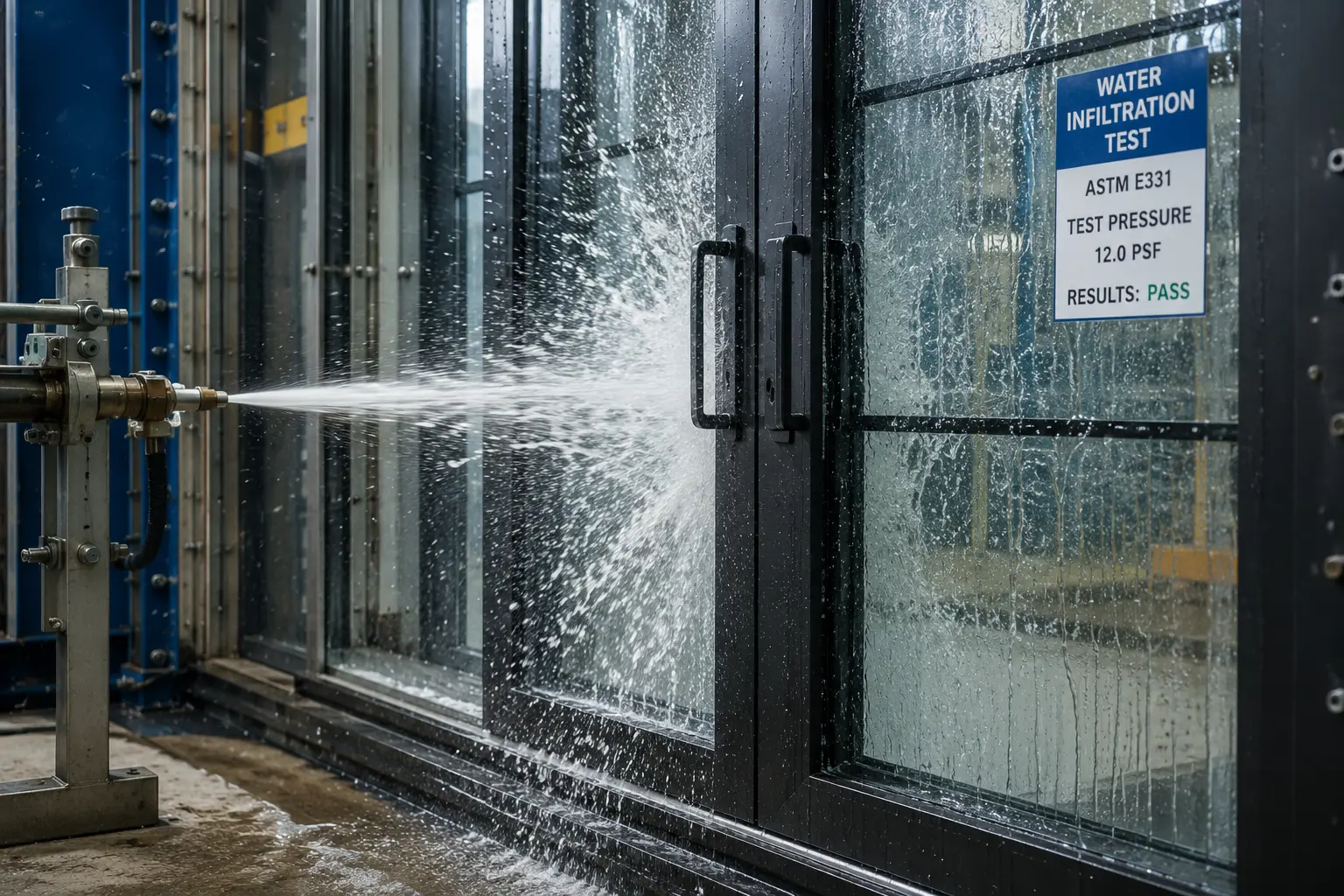
This is not a standalone R&D flex. The introduction of in-house fire lab testing further differentiates Saint-Gobain's commercial construction offerings, advancing a key component of the company's "Lead and Grow" strategy announced last October. When combined with the existing large-scale acoustic and weather testing capabilities available at Northborough, Saint-Gobain will be able to offer large-scale, on-demand customizable testing to meet a wide range of commercial construction needs.
The practical read: Northborough now offers a one-stop envelope testing stack—fire, acoustic, and weather—under one operator. For project teams designing complex mixed-use, healthcare, and high-rise residential envelopes where fire, sound, and water performance intersect at the same detail, that consolidation is genuinely useful.
What to Watch
Two things are worth tracking over the next 12 to 18 months. First, whether the lab pursues third-party accreditation that would allow it to issue listings recognized outside Saint-Gobain's own certification workflow. Second, whether the facility opens capacity to customer-collaborative testing—joint R&D with framing, glazing, and sealant partners where fire-rated perimeter details still trip up field mock-ups.
For the specification community, the near-term takeaway is simpler: expect Saint-Gobain product updates, revised UL listings, and new hybrid assembly options to arrive on a faster cadence than they have historically. That's a small but real shift in how the fire-rated portion of a spec sheet is likely to evolve over the next two years.