
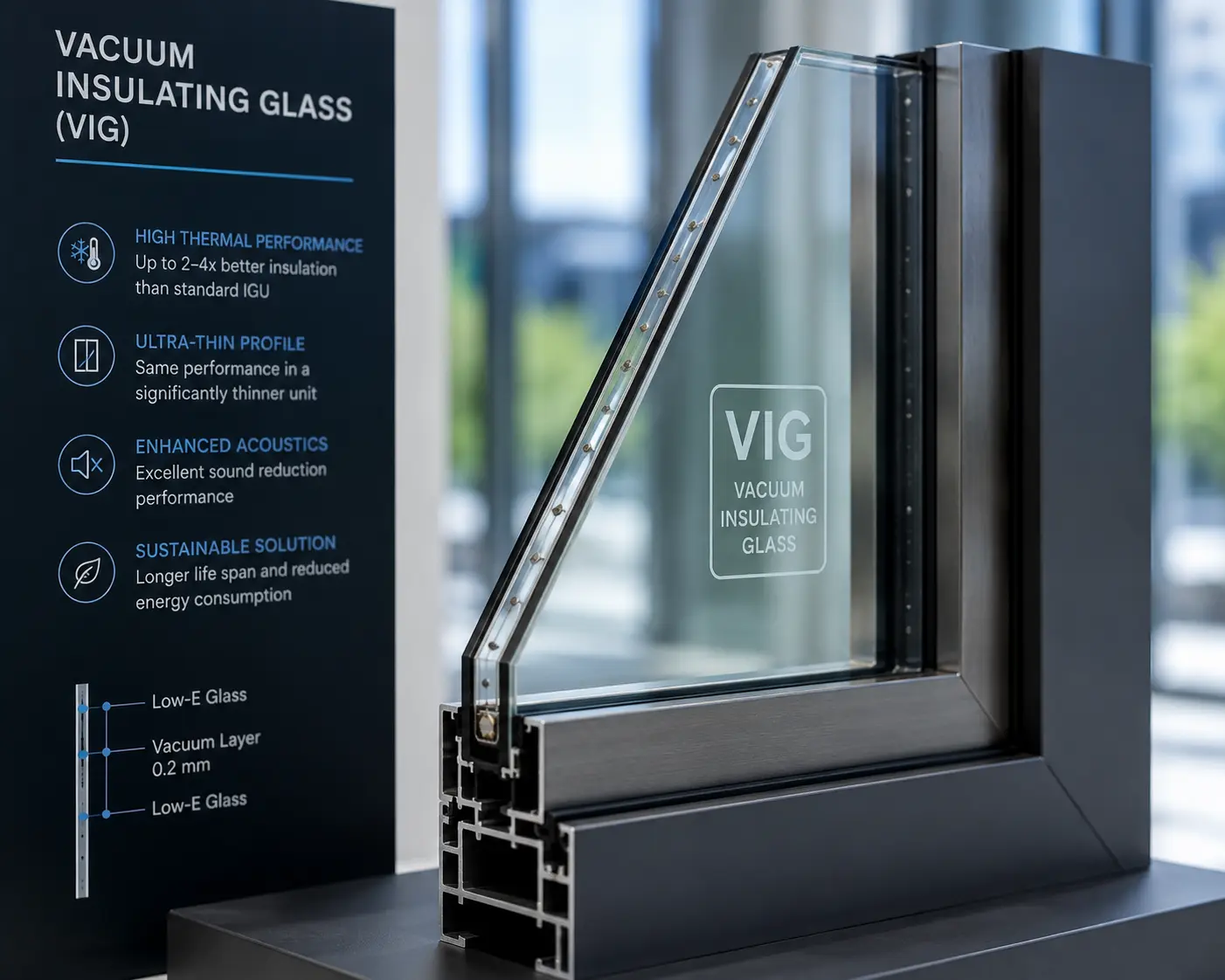
LuxWall's Enthermal vacuum-insulating glass has cleared structural silicone glazing testing and is now being promoted for commercial curtain wall use. With a 0.043 U-factor and a profile as thin as 8mm, it reopens the triple-pane-versus-double-pane math for architects chasing tightening envelope energy codes.
The Story
Architect's Newspaper's September 8 roundup of new glazing innovations put LuxWall's Enthermal product line squarely in front of commercial facade designers, framing it as a vacuum-insulating glass (VIG) alternative that outperforms conventional double- and triple-pane IGUs while occupying a fraction of the sightline. The company describes Enthermal as a product crafted with patented Transparent Insulation science that virtually eliminates conductive, convective, and radiative heat transfer for performance that exceeds conventional double- and triple-pane systems in an ultrathin profile of 8 to 12 millimeters.
The technical case is aggressive. LuxWall's Enthermal Plus delivers a 0.043 U-factor — more than 5X the performance of standard double-pane units and 3X the performance of triple-pane units. That number, if it lands consistently in third-party mockups, changes the assumptions specifiers use to hit ASHRAE 90.1 and the 2024 IECC without pushing to bulky triple-pane assemblies.
Why Curtain Wall Compatibility Is the Real News
VIG has existed in theory for years. The barrier to commercial adoption has always been whether the edge seal and pillar array could survive the loads, thermal cycling, and structural glazing environments that define modern facades. Earlier this year, LuxWall closed that gap.
LuxWall announced its Enthermal product line is now available for use in Structural Silicone Glazing (SSG) applications, having completed structural and thermal testing validating the compatibility of its Transparent Insulation with SSG systems widely used in modern commercial façades. The testing confirms that the vacuum insulation technology can be integrated into contemporary window and façade systems, overcoming a long considered unachievable challenge within the industry.
The test program was not trivial. The program evaluated Enthermal under static wind loads, point and uniform loading, compressive shear, dynamic pressure cycling and asymmetric thermal shock conditions, with ASTM E330 testing demonstrating resistance to wind pressures exceeding 140 pounds per square foot. On the seal durability question that has historically killed VIG in commercial applications, large-area shear testing validated the perimeter seal with production units sustaining loads up to 2,500 pounds without shear failure versus 600 pounds for a traditional insulating glass system. And for hurricane-zone specifiers: dynamic pressure testing to ASTM E1886 and E1996 simulated hurricane-force conditions up to approximately 230 mph equivalent wind speeds, while thermal shock testing confirmed durability under uneven façade temperature exposure up to 194 degrees Fahrenheit.
Practical Implications for Specifiers
For architects and facade consultants: The 8–12mm range matters. Because Enthermal delivers wall-level insulation in a profile 2X to 3X thinner than double pane glass, specifiers can hold traditional 1-inch glazing pockets while dramatically improving U-factor, or use the thinner build to preserve sightlines on landmark and adaptive-reuse projects. Enthermal Plus takes a different path — it is a 1-inch IGU combining LuxWall's slim-profile vacuum technology with a traditional insulating glass unit — meaning it drops directly into standard frame catalogs from Kawneer, YKK AP, EFCO, and Tubelite without redesigning the pocket.
For glazing contractors: SSG compatibility is what unlocks unitized curtain wall bidding. Two-sided and four-sided SSG systems dominate high-rise commercial construction, and LuxWall's testing confirms that its Transparent Insulation is fully compatible with two-sided and four-sided SSG systems. That widens the addressable spec sheet from residential Ultra Series and window-wall to actual unitized facades.
For building product manufacturers: Kolbe has already brought the product to market in wood-and-clad residential lines. The SSG greenlight now pulls VIG into the commercial extrusion ecosystem, and framers who don't have a vacuum-glass story going into GlassBuild America 2026 will face pointed questions from developers under Inflation Reduction Act envelope-incentive pressure.
For retrofit economics: LuxWall is pitching glass-only swaps hard. Glass-Only Retrofits fit existing frames, avoid capital intensive full window replacements, and deliver an accelerated payback period of 3 to 10 years. On a portfolio-scale Class A office repositioning — where full curtain wall replacement is a non-starter — that math is the difference between a code-triggered facade project happening and being deferred.
The Bigger Signal
VIG has spent the last decade in demonstration projects and pilot buildings. The Architect's Newspaper feature, combined with the SSG test package, signals that the technology is crossing into mainstream commercial specification. Combined with AeroShield's aerogel-coated glazing hitting the IGDB and the tightening 2024 IECC U-factor thresholds, the assumption that 'triple-pane is the only path to sub-0.20 U-factor' is now up for debate — and the spec sheets written this fall will start reflecting it.