
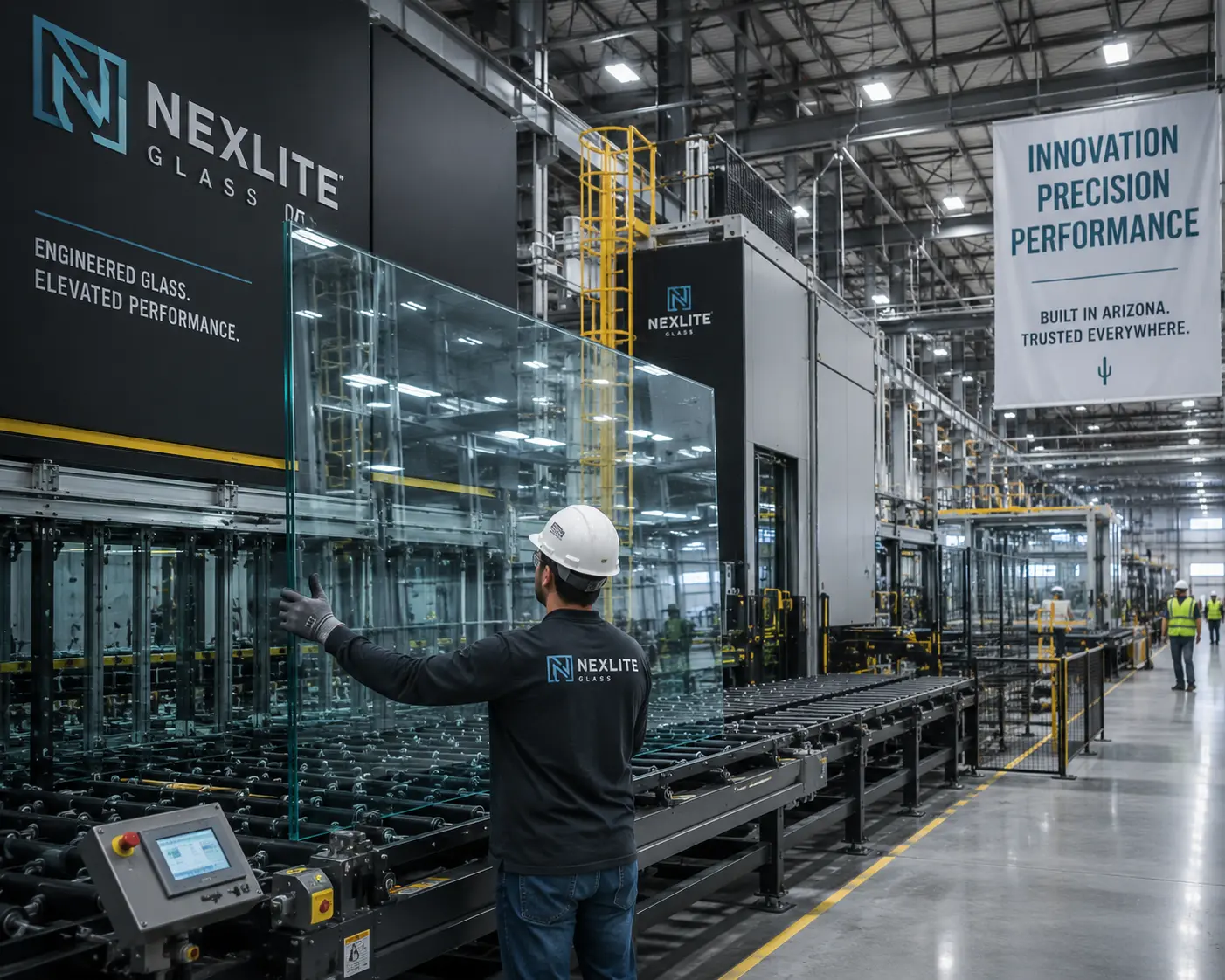
Glass Futures, NVIDIA, and the University of Liverpool's Virtual Engineering Centre have installed an AI-driven digital twin of a pilot glass furnace in St Helens. The system lets manufacturers simulate hydrogen firing, electric boost, and batch tweaks before touching real equipment—and it could shorten the path to lower-embodied-carbon architectural glass.
A Furnace You Can Crash Without Breaking It
Decarbonizing architectural float glass has always run into the same wall: float lines are huge, hot, and expensive to stop. You don't shut down a 600-ton-per-day furnace to test a new fuel mix or a different cullet ratio. That's the problem a new project out of St Helens is trying to solve—and as of June 8, it's officially live.
Glass Futures has launched an AI-driven digital twin of its pilot glass furnace, developed with NVIDIA and the University of Liverpool's Virtual Engineering Centre (VEC). The AI-GLASS project has been running for the last year with NVIDIA and the VEC, which has created a fully immersive model viewed through VR headsets. The digital twin enables manufacturers to test things industry has never tried before, allowing them to try new fuels, electric heating, bubbling and other techniques and get an accurate prediction of how the end product will turn out.
That "end product" matters to anyone writing envelope specs. Float glass is the substrate for low-E coatings, IGUs, laminates, and spandrel—and its embodied carbon shows up on every EPD a fabricator hands to a LEED or BREEAM team.
What's Actually Inside the Model
This isn't a marketing render. The technical stack is doing real work:
- NVIDIA RTX Pro 6000 GPUs combine real pilot-line data with 16 sensor points and NVIDIA PhysicsNeMo, meaning the model is informed by the laws of physics.
- Rather than just learning from real and simulated data, the system uses a physics-informed neural network that digests inputs through physics principles, not just statistical correlation.
- The digital environment lets manufacturers experiment with transitioning to hydrogen or biofuels, and adjusting batch compositions without disrupting production or risking equipment, and instantly predicts the impact on energy use, emissions, melt quality, and operating costs.
- A fully immersive 3D twin of the entire Glass Futures site—built from BIM data, LiDAR scans, and UAV photogrammetry—supports training, safety planning, and remote walkthroughs.
AI-GLASS is part of a wider £1.5 million Innovate UK funding programme being delivered through Make UK.
Why Spec Writers and Envelope Pros Should Care
The building envelope industry has spent the last 18 months absorbing a wave of low-carbon glass claims—Pilkington Mirai, Saint-Gobain Oraé, AGC Low-Carbon Planibel, Vitro's reduced-carbon Solarban substrates. Behind every one of those EPDs is a furnace decision: more cullet, more electric boost, different fuel, different batch chemistry. Each of those changes carries production risk that, until now, could only be quantified by running trials on actual lines.
A physics-informed digital twin compresses that R&D cycle. According to VEC's chief technology officer, the platform lets manufacturers explore new fuels and materials in seconds, reducing risk and accelerating progress toward sustainable, efficient and cleaner glass production.
Practical implications:
- Faster low-carbon substrate rollouts. If fuel switching and batch trials can be modeled before they're run, the cadence of new low-embodied-carbon float products on the market should accelerate—giving architects more EPD-backed options for Buy Clean procurement, 179D documentation, and LEED MRc2 credits.
- Better data for embodied carbon calculators. Tools like EC3, OneClick LCA, and Tally rely on industry-average GWP numbers for flat glass. As manufacturers run more validated decarbonization scenarios, the gap between industry averages and best-in-class products will widen—which is exactly what spec writers need to differentiate products in Division 08 88 00.
- A template for cross-industry use. Glass Futures plans to work with members and cross-industry partners in steel, ceramics and other sectors on projects using the digital twin and the real pilot line. Aluminum extrusion, the other carbon-heavy half of a curtain wall assembly, is an obvious next target.
The Bigger Picture
The UK float glass sector has been vocal about being underfunded in the country's industrial decarbonization plans—British Glass warned just weeks ago that domestic capacity is at risk without targeted support. AI-GLASS doesn't fix the capital gap, but it does something tactically important: it lets a relatively small pilot facility punch above its weight on R&D, and it gives UK manufacturers a tool to de-risk the fuel transitions that will define whether they survive the 2030s.
For architects and envelope consultants, the takeaway is straightforward. The float industry's decarbonization curve just got a software accelerant. Expect more low-carbon glass options, more granular EPD data, and—eventually—less of a performance gap between "standard" and "low-carbon" architectural glass.