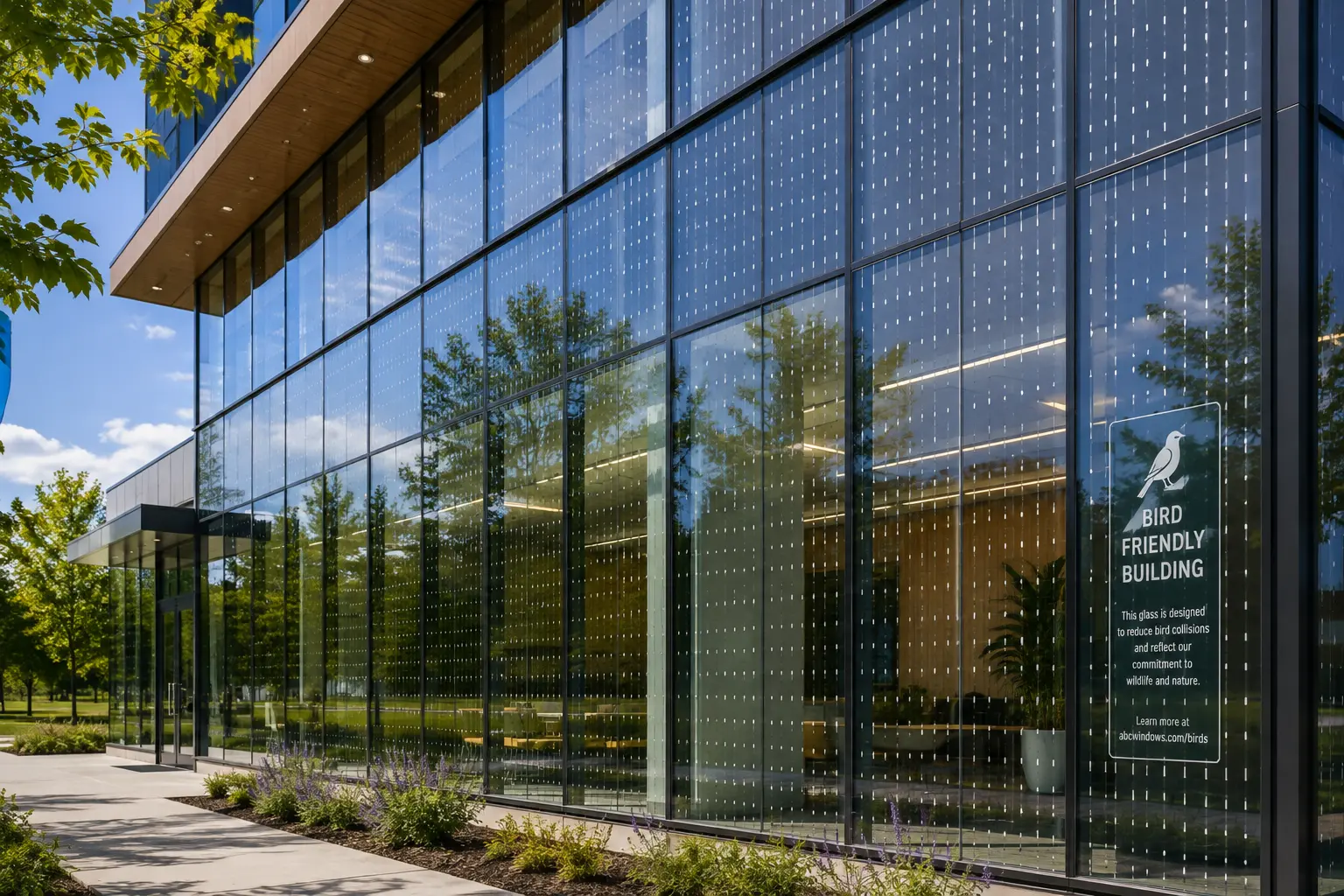
EnduroShield is officially launching BirdWise Coating at GlassBuild America 2026 — an inorganic, UV-stable bird-friendly treatment applied directly to surface #1 of any glass type. Unlike printed or etched solutions, it can be applied in-line, post-production, or as a retrofit, giving specifiers a new lever for jurisdictions where bird-collision codes are already in force.
A different approach to bird-safe glazing
Bird-friendly glass has, until now, been a fabrication decision. If a project needed compliant glazing, the spec typically called for laser-etched dots, ceramic frit patterns, or a UV-reflective interlayer — all of which had to be locked in before the lite was fabricated, coated, or laminated. That's fine for new construction where the code trigger is known at design development. It's a much harder problem for adaptive reuse, envelope retrofits, and projects where a bird-collision ordinance is passed mid-construction.
That's the gap EnduroShield is trying to close at GlassBuild America 2026. At this year's show, EnduroShield will officially launch BirdWise Coating, a new bird-friendly glass coating solution designed to give glass companies a more flexible way to meet the growing demand for bird-safe glazing.
Unlike traditional printed or etched bird-friendly glass solutions, BirdWise is an inorganic, UV-stable coating applied directly to surface #1 of any glass type. The company is positioning it as a coating rather than a fabrication process, which is the meaningful distinction for anyone writing specs or managing envelope scope.
What makes the delivery model different
The launch details matter more than the marketing language. According to EnduroShield, the coating can be applied during production, after production, or as a retrofit, giving glass companies more flexibility in how they supply bird-friendly glass.
That three-way application window is the news. Traditional bird-friendly solutions generally require one of the following:
- First-surface laser etching — locked in at the float or fabrication stage
- Ceramic frit printing — requires a printing line and a heat treatment cycle
- UV-patterned interlayers — decided at the lamination stage
- Patterned low-e or acid-etched lites — coating-line decisions made months upstream
A coating that can be sprayed onto a finished lite — or applied to installed glass in the field — collapses that lead-time constraint. For fabricators, it means one clear inventory can serve both standard and bird-friendly orders. For glazing contractors, it opens the door to retrofit work on existing curtain wall, storefront, and window wall assemblies that would otherwise require full IGU replacement to hit an ordinance.
Why this matters for specifiers right now
Bird-safe glazing is no longer a niche request. Municipal ordinances in New York City, San Francisco, Toronto, and a growing list of others already reference threat-factor scoring under the American Bird Conservancy framework, and federal projects have their own guidance. The pipeline of retrofit and adaptive-reuse work in those jurisdictions is meaningful — and until now, hitting compliance on an existing building has often meant swapping lites.
The practical implications for the three main buyer groups:
- Architects and specifiers. A coating-based option gives you a compliance path when a client asks late in DD or CDs whether the project can achieve bird-friendly status without redesigning the glass package. It also gives you a lever for LEED Pilot Credit 55 and equivalent sustainability scorecards on projects where fabrication decisions are already locked.
- General contractors and glazing subs. Retrofit and change-order scope becomes cleaner. Instead of tearing out IGUs, the crew is applying a coating — a labor scope, not a materials-lead-time scope. That has real implications for schedule risk on projects where a bird ordinance gets triggered after glass is on site.
- Fabricators and coaters. EnduroShield is meeting with manufacturers, fabricators, processors, glaziers and project teams at Booth #3629 in Las Vegas — a signal that the company is pursuing a channel strategy across every stage of the value chain, not just selling to end users.
Open questions worth asking on the show floor
A few things aren't public yet and deserve direct questions in Las Vegas: pattern geometry and threat-factor rating under the ABC 2×4 rule, long-term durability data in freeze-thaw and coastal exposure, cleanability and warranty interactions with existing surface coatings, and whether the product will be listed in ABC's Bird Collision Deterrent Materials Database — the reference most specifiers cite. Also worth pressing: how BirdWise interacts with low-e coatings when applied to already-glazed IGUs, since surface #1 application on an installed insulating unit is a different physical scenario than factory application on a monolithic lite.
If the answers hold up, this is a genuinely new tool in the bird-safe glazing toolkit — and one that finally addresses the retrofit problem the current generation of products has largely left unsolved.