
Apogee's EFCO curtain wall, storefront, and door lines just anchored one of 2026's most unusual historic-preservation projects—a 52,000-square-foot Kentucky judicial center built around an 820-ton courthouse that was lifted, moved 75 feet, and re-set on a new foundation. Here's what the spec sheet reveals about the state of muntin-grid replication work.
A 1828 Courthouse, Moved Three Times, Re-Skinned With EFCO
Historic replication rarely comes with a construction sequence this dramatic. The newly reopened Oldham County Judicial Center in La Grange, Kentucky, brings together nearly two centuries of local history and modern judicial services in a 52,000-square-foot government project on Main Street that preserves and incorporates the county's historic courthouse—Kentucky's second-oldest courthouse still in existence, listed on the National Register of Historic Places and continuously occupying the site since 1828.
To make room for the addition, WEHR Constructors lifted the 6,300-square-foot, 820-ton courthouse approximately four feet off its foundation and relocated it about 75 feet onto a newly constructed foundation before work began on the expansion. Local reporting places the move at 44 feet backward, 22 feet west, and 75 feet south. The building reopened March 2, 2026.
What's most interesting for spec writers is what happened next: Sherman Carter Barnhart Architects designed the expanded judicial center to reflect the courthouse's original Renaissance Revival style, and the fenestration package had to disappear into that language.
The Spec Sheet: EFCO 5600, 403i, and D500
Apogee Architectural Metals' EFCO brand landed the full envelope package. The systems selected:
- EFCO 5600 Series Curtain Wall for the primary vision-glass expanses
- EFCO 403i Storefront for ground-level and transitional glazing
- EFCO D500 Doors for entrances
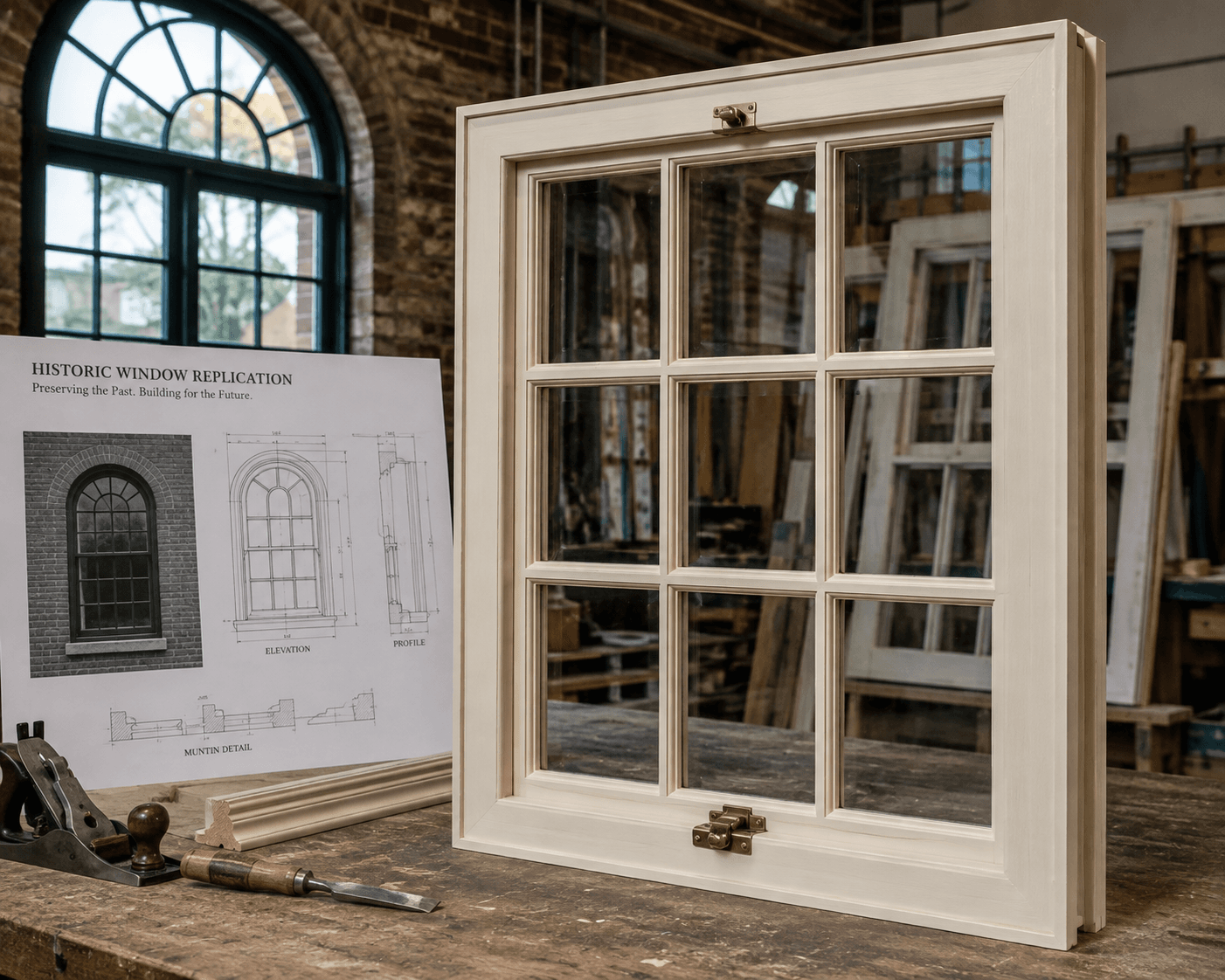
Stanley Schultze & Co. installed more than 300 individual units for the center's windows and doors. The systems match the style, scale, and size of the former windows and doors, complete with era-appropriate muntin grids—a detail that historic district review boards typically treat as pass/fail.
The renovation preserved the grandeur of the courthouse's main entrance, signature bell tower cupola, projected brick pilasters, detailed cornices, and the look of its tall, narrow, arched windows. Every one of those elements sits inside the sightline tolerance of the new aluminum systems.
Why This Project Matters for the Broader Historic Replication Market
A few practical takeaways for architects, glazing contractors, and product manufacturers:
1. Muntin-grid replication is a real product category, not a workaround. EFCO's ability to deliver "era-appropriate muntin grids" across a curtain wall, a storefront, and a door line—on the same job—signals how mature the historic-replication space has become inside mainstream commercial aluminum catalogs. Firms competing for state historic tax credit work or Section 106 review projects should confirm their preferred system vendors can hit the same three-product coordination.
2. Government work is still driving the historic-envelope pipeline. A 52,000-square-foot courthouse addition isn't a boutique project. Kentucky's Administrative Office of the Courts authorized this project in 2018 with a maximum annual use allowance of $42.9 million. That kind of dollar figure, coordinated through a state judicial construction pipeline, is exactly the kind of steady-state demand that keeps regional glazing contractors like Stanley Schultze staffed and specialized.
3. The Apogee/EFCO integration story is showing up on real projects. EFCO now sits inside Apogee Architectural Metals alongside Wausau, Tubelite, Linetec, and Alumicor. Landing curtain wall, storefront, and entrance on a single historic-replication package is precisely the cross-brand sell the reorganization was designed to enable. Expect more single-source EFCO/Apogee packages on courthouse, university, and municipal projects where three separate submittal packages used to be the norm.
4. Construction-manager coordination is doing heavy lifting. WEHR Constructors coordinated the architect, glazing contractor, and Murfin Commercial Building Products (Murfin CBP) as the manufacturer's rep. On a job where the host building was literally being moved during preconstruction, that CM-led coordination is what kept the fenestration submittal schedule from collapsing. Specifiers running similar hybrid preservation/addition projects should build the manufacturer's rep into the schedule earlier than usual—shop drawings on muntin-grid replication routinely take two to three review cycles.
The Takeaway
Historic replication used to be the province of specialty steel window houses. This project shows the mainstream aluminum curtain wall, storefront, and door catalogs can now hit Renaissance Revival aesthetic targets on a National Register site while still delivering the thermal and low-maintenance performance a working courthouse needs for the next several decades. For architects fielding preservation-plus-addition assignments, that widens the pre-approved manufacturer list considerably—and for Apogee, it validates the cross-brand pitch.