Cardinal Glass Industries' new Divert bird-friendly glass eliminates films, interlayers, and UV-only coatings by laser-etching directly into surface one—giving specifiers a permanent, code-ready solution just as ASHRAE 189.1-2026 and the 2027 IGCC bring bird-safe glazing into the mainstream code stack.
A Coating-Portfolio Solution to a Code Problem
Cardinal Glass Industries has announced Divert, a laser-etched, first-surface bird-friendly glass slated for launch in the fourth quarter of 2026. The product is fully integrated into Cardinal's coated glass portfolio and, per company officials, eliminates the need for films, interlayers, acid etching, and UV-only coatings—the four approaches that have dominated bird-safe spec sheets for the past decade.
The timing is not accidental. Bird-friendly glazing has moved from a coastal-city ordinance into the mainstream code stack. Addendum o to ASHRAE 189.1 was approved by ASHRAE and ANSI on January 30, 2026, introducing a new bird-friendly design requirement for building facades to promote uniformity around glazing requirements—written as a jurisdictional option so AHJs can adapt it to regional flyways. The National Glass Association's Best Practice for Bird Friendly Glazing Design Guide is now referenced in language approved for the 2027 International Green Construction Code and ASHRAE 189.1-2026.
For spec writers, that shifts bird-friendly from a niche credit to a code-driven line item.
What's Actually Different About Divert
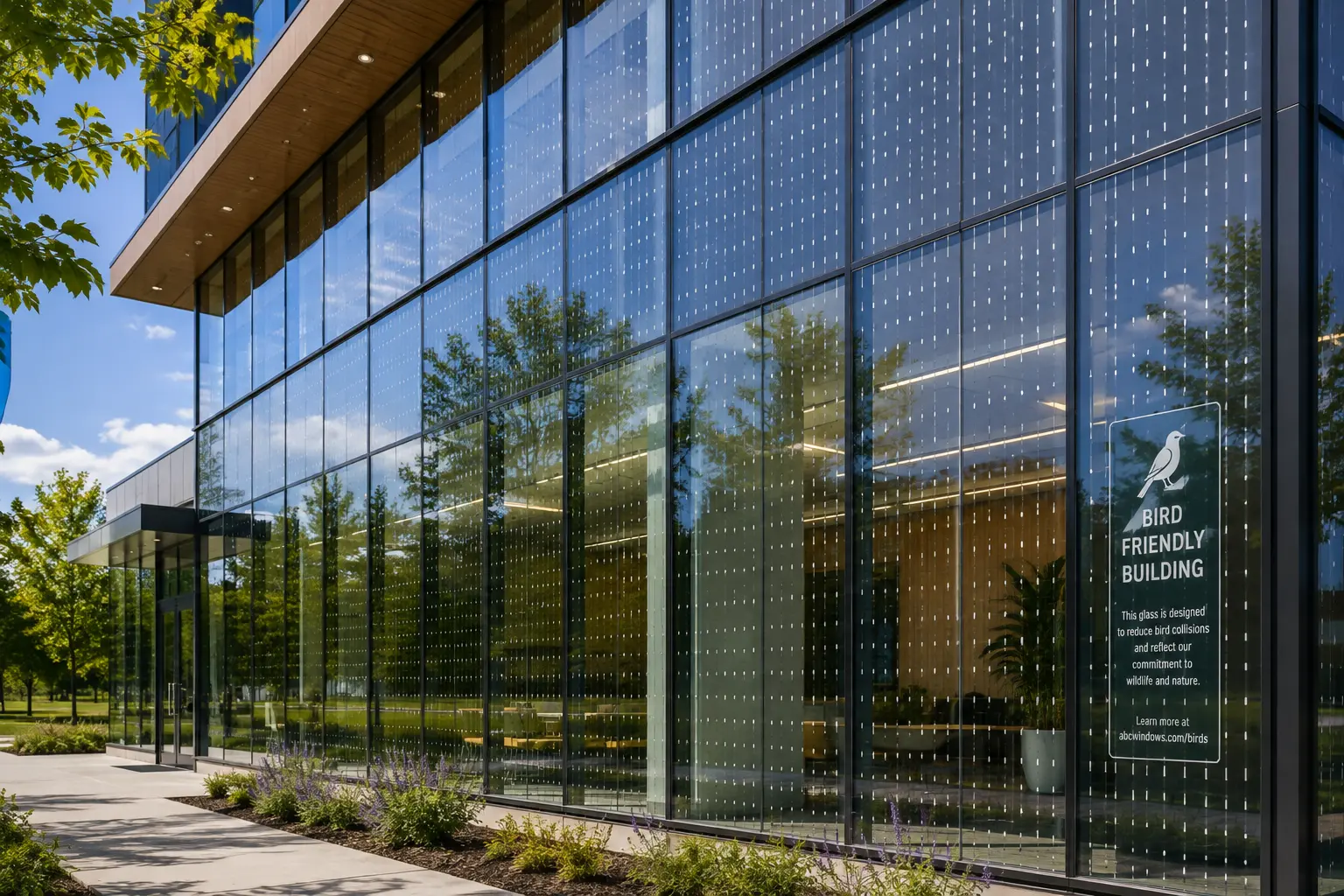
Divert uses precision laser etching to create first-surface patterns visible to birds but barely noticeable to occupants, with tightly controlled dot size, spacing, and pattern geometry that comply with bird-friendly standards. Because the pattern is physically etched into the glass rather than applied, it maintains lasting performance through manufacturing, handling, and years of exposure to the elements without peeling, fading, or delaminating.
A few technical specifics matter for the facade team:
- Surface-one etching, surface-two coating. With the deterrence pattern designated to surface one, surface two remains open for any Cardinal LoĒ coating, preserving thermal and solar-control flexibility.
- Grid geometry aligned to major ordinances. Divert's traditional pattern uses a 2×2 inch grid, a configuration aligned with widely used prescriptive bird-safe design guidance and stringent code pathways such as New York City Local Law 15 and the Toronto Green Standard.
- Neat+ standard. Each unit ships with Cardinal's Neat+ coating, which uses sunlight to help the glass stay naturally cleaner for longer—a maintenance advantage on tall, hard-to-reach facades where first-surface etching lives.
- Availability. The product is offered in annealed and temperable versions, with a randomized pattern option for projects where a more organic aesthetic is required.
Why First-Surface Matters
First-surface solutions are widely recognized as the most effective for reducing bird collisions, according to Cardinal's R&D technical services manager Jordan Lagerman. That is echoed by the American Bird Conservancy's threat-factor testing regime, which most jurisdictional codes now reference. Interior patterns, UV-only coatings, and films applied to surface four typically underperform against reflection-driven collisions—the failure mode that kills the most birds.
Up to 2 billion birds are killed yearly in the United States due to collisions with glass, based on data from the U.S. Geological Survey's Bird Banding Laboratory, with 56% of those collisions occurring on low-rise buildings—the exact zone where most commercial and mid-rise glazing lives.
Practical Implications for Architects and Contractors
For architects: The historical trade-off between bird-friendly compliance and coating performance is narrowing. Because Divert isolates the etch on surface one, the vision-package spec can still call for a high-performance Cardinal LoĒ coating on surface two without hunting for a bird-friendly override product. That preserves U-factor, SHGC, and visible-light-transmittance targets on the same spec sheet.
For contract glaziers: No films, no interlayers, no acid-etched substrates in the fabrication path means the bird-friendly SKU flows through the same coating and IGU lines as the rest of the Cardinal portfolio. Expect fewer split-lot orders, fewer film-adhesion callbacks, and cleaner handling on-site since the etched pattern won't scuff off during installation.
For manufacturers and code consultants: Divert enters a market where Vitro's BirdSmart and Viracon's SoarSafe already offer first-surface laser-etched options. The competitive pressure is now on price, pattern variety, and coating pairings—not on whether laser etching itself is a viable path. Expect specifications to start naming laser-etched first-surface glass as the default bird-friendly pathway in jurisdictions adopting ASHRAE 189.1-2026 language.
The Bottom Line
Bird-friendly glass has spent a decade as a specialty add-on. With code adoption accelerating and Cardinal, Vitro, and Viracon all offering first-surface laser-etched product families integrated with their low-E coatings, the category is graduating into standard commercial spec. Divert's Q4 2026 launch puts a third major low-E manufacturer's coating portfolio behind that shift—right as the codes catch up.