
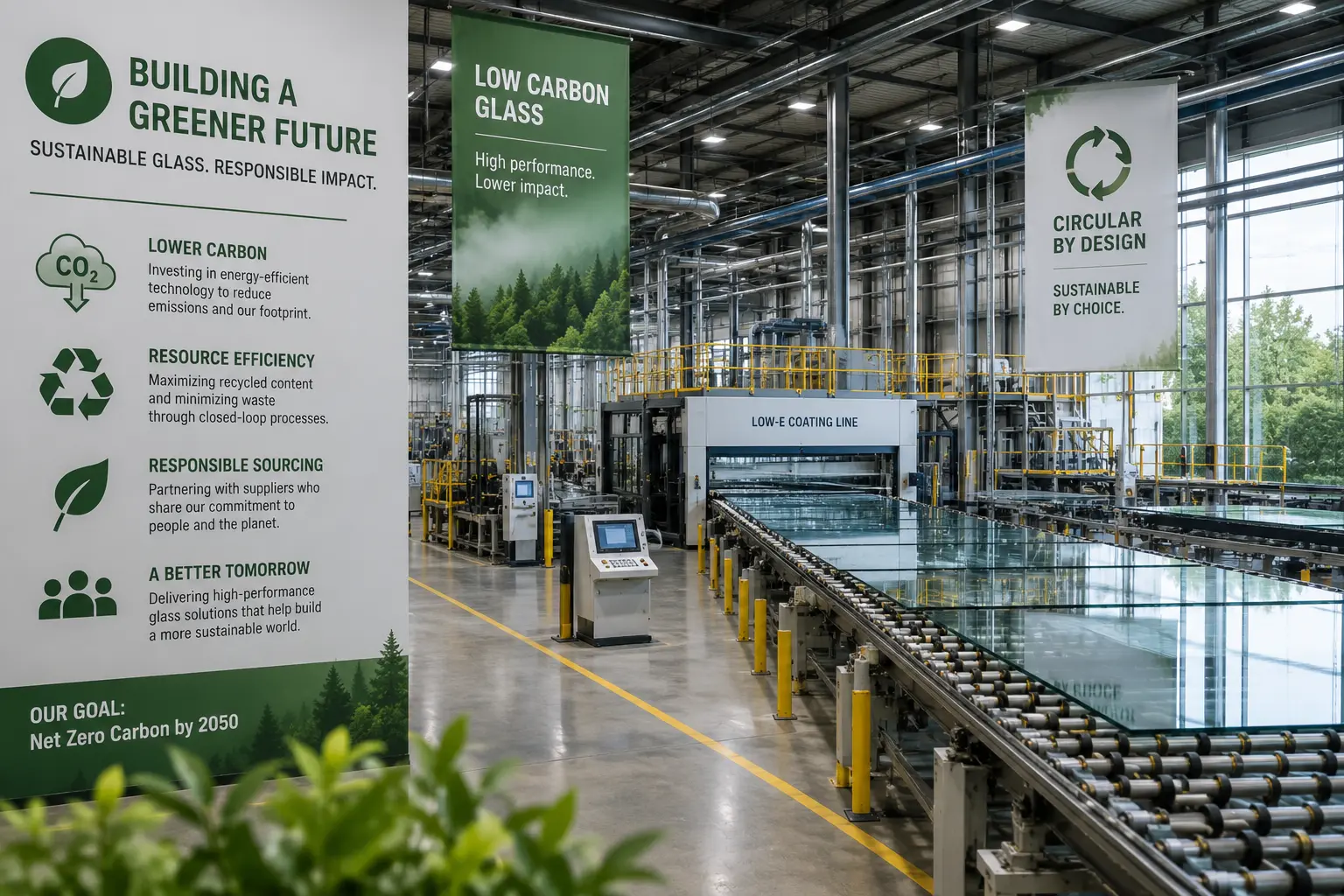
Cardinal Glass Industries is deploying a hot potassium carbonate CO₂ capture system from K2-CO₂ aimed at removing 95% of process emissions from float lines. The August 2026 Glass Magazine cover story lays out how the largest U.S. residential float producer plans to decarbonize without changing the furnace—and why spec writers are about to have a new low-carbon option.
A Carbon Capture Play That Doesn't Touch the Furnace
While most of the flat-glass industry's decarbonization headlines have focused on hybrid electric furnaces and hydrogen firing, Cardinal Glass Industries is taking a different route: bolt a large-scale CO₂ capture system onto existing float lines and leave the furnace alone.
Through a partnership with K2-CO₂ of Padova, Italy, Cardinal is deploying CO2 capture technology designed to remove up to 95% of process CO₂ emissions from participating float glass lines. The scale of the emissions problem is worth understanding before evaluating the fix. Float glass manufacturing is energy intensive. Cardinal FG's large-scale furnaces run 24 hours a day, 365 days a year, with each plant occupying more than 700,000 square feet and consuming substantial natural gas and electricity to keep glass in a continuous molten state at temperatures of around 2,900°F (about 1,600°C). This energy, when applied to glass-making raw materials, also generates CO2.
The technology behind the capture rate matters for anyone evaluating vendor claims. K2-CO₂ will provide a fully integrated CO₂ capture system, powered by the Hot Potassium Carbonate (HPC) process with its licensor Giammarco Technologies. Leveraging glass manufacturing knowledge, advanced gas pre-treatment methods and turn-key plants experience, the K2-CO₂ system is designed to significantly outperform conventional approaches.
K2's solution includes stripping CO₂ from flue gas via hot potassium carbonate. The remaining flue gas exits the exhaust stack, while the CO₂-loaded solvent passes through a stripping column for separation. The HPC is reused in absorption while the CO₂-rich gas is sent for use or storage. The system is designed to operate as a closed loop without additional heat input, extracting all heating and cooling needed from the flue gas stream throughout the process. Translation: no new natural gas burn to run the capture step—a critical detail when the goal is net reduction rather than emissions shuffling.
Why This Is Different From VOLTA and Furnace-Replacement Strategies
Hybrid furnaces (like the Saint-Gobain/AGC VOLTA pilot) require multi-year rebuilds and change the metallurgy of the melt. Cardinal's approach layers new hardware onto existing lines, which is a very different capital and risk profile. Cardinal describes carbon capture as a path towards decarbonization that does not affect the manufacturing process and builds on work over the last decade to voluntarily install additional air pollution controls at float plants to manage nitrogen oxides, sulfur dioxide and particulate emissions.
The integration challenge is nontrivial. Float furnaces and their air pollution control systems are already tightly integrated, so adding new equipment like absorbers, ductwork and carbon dioxide handling infrastructure requires creative engineering and careful layout planning. The carbon capture system also must operate in harmony with existing air pollution control devices. Any imbalance can ripple back into furnace performance.
What It Means for Spec Writers and EPDs
Cardinal already produces a large share of the residential LoĒ coated glass in North America, and its glass moves through the Andersen, Marvin, Pella, and Jeld-Wen supply chains. A meaningful cut to embodied carbon at the substrate level ripples through every EPD downstream.
Key implications:
- Scope 3 math changes. Window and door OEMs sourcing Cardinal float will see a lower embodied carbon number in their EPDs without reformulating IGUs or changing coatings. For LEED v5 and BREEAM projects chasing whole-life carbon, that's a paperwork win.
- A new differentiator against imported float. With tariffs and freight already reshaping the flat-glass supply picture, domestically produced low-carbon float becomes a spec-sheet edge for U.S. projects with sustainability mandates.
- Carbon accounting for the captured CO₂. Cardinal officials say the annual CO₂ captured by one of K2-CO₂'s systems surpasses the amount sequestered by planting 1.6 million trees and growing them for a decade. Whether the captured stream goes to utilization or geologic storage will determine how it books in an EPD.
The Broader Signal
Cardinal isn't just chasing carbon numbers. From a landmark carbon capture partnership targeting a 95% carbon dioxide reduction at float plants, to a switchable privacy glass that's rewriting expectations for residential and commercial design, the company is operating at the intersection of environmental responsibility and product innovation.
For architects, contractors, and glazing consultants, the practical takeaway is this: the low-carbon float category is no longer a European-only conversation. When the K2-CO₂ system comes online, U.S. spec writers will have a domestically produced, coating-ready substrate with a credible 95%-capture story attached to it. Expect that number to start showing up in submittal packages—and in the questions from owners chasing embodied-carbon targets.