
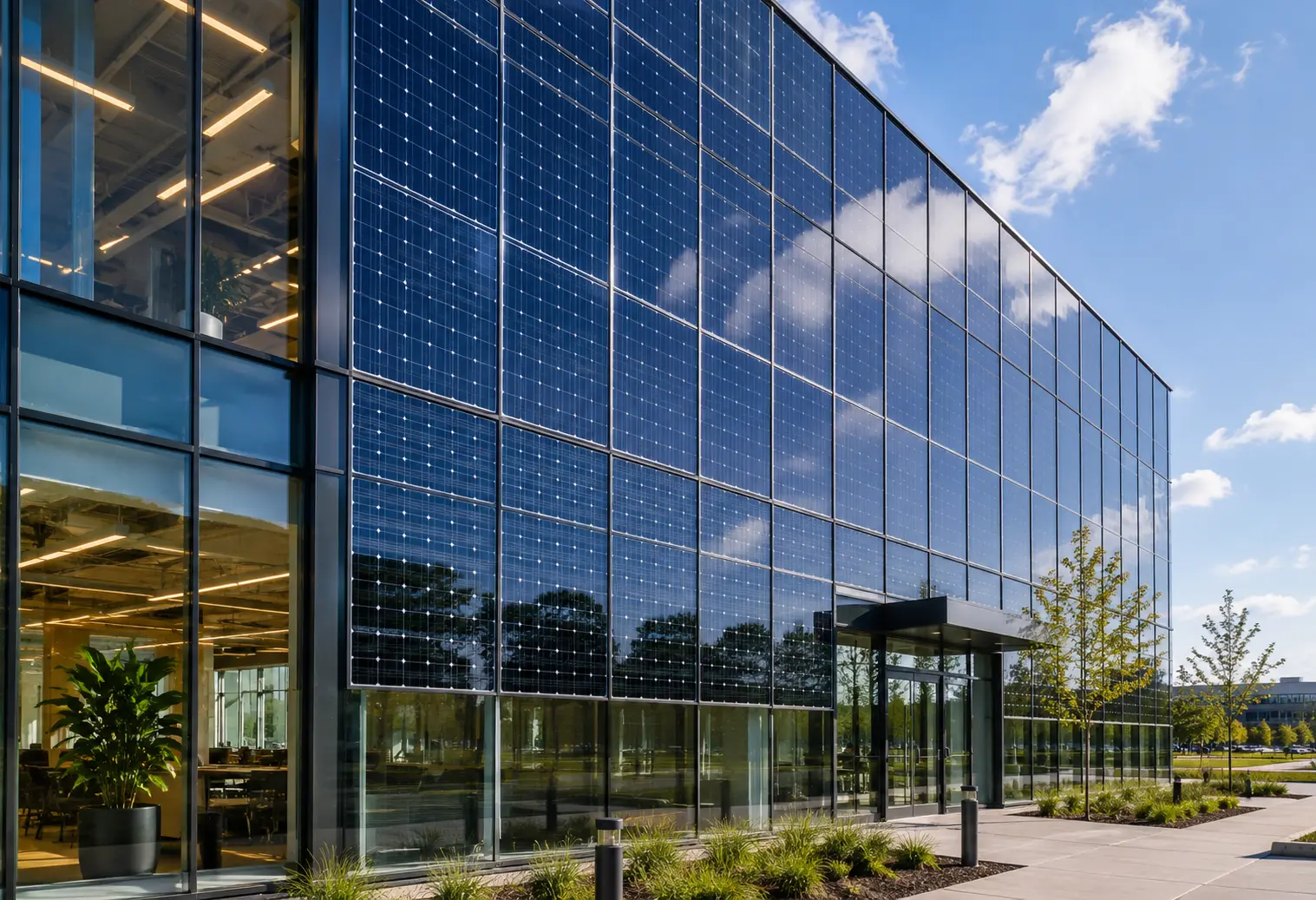
ClearVue Technologies' Gen 3 Vision Glass has passed EN 1279-5:2018, the European durability standard for IGU edge seals—with electrical cables routed through the seal itself. Here's why the certification matters for façade engineers weighing BIPV against conventional curtain wall glazing.
A Quiet Milestone for Power-Generating Façades
Building-integrated photovoltaic (BIPV) glazing has spent the last decade fighting two stigmas: questionable long-term durability, and the suspicion that running electrical conductors through an insulating glass unit (IGU) seal is a moisture-ingress problem waiting to happen. On June 24, ClearVue Technologies announced a result that takes a measurable bite out of both concerns.
ClearVue Technologies says its Gen 3 Vision Glass has passed a key European certification standard, with the company stating that its Gen 3 Vision Glass successfully passed testing under EN 1279-5:2018, the European standard governing the long-term sealing performance of insulating glass units used in construction. For façade engineers and spec writers, that's the headline. EN 1279-5 is the accelerated-aging gauntlet that conventional IGUs run before they're allowed near a commercial curtain wall—and ClearVue's product just cleared it with power cables routed through the perimeter seal.
Why the Seal Question Matters
IGU edge seals are the single most failure-prone component in a modern curtain wall. Argon retention, low-E coating protection, and resistance to condensation all live or die at the spacer-to-glass bond line. Drilling that line to feed electrons out of a PV-active interlayer has historically been the Achilles' heel of vision-area BIPV.
According to the company, the certification demonstrates that its Gen 3 design is compatible with industry-standard aluminium spacers in a double-glazed unit configuration—and aluminium spacers are widely used by double-glazed unit manufacturers and specified in commercial curtain wall systems. That compatibility is the spec-sheet detail that matters. It means a fabricator doesn't need a bespoke spacer line to assemble these units.
ClearVue said its technology enables electrical power to pass through the seal of a double-glazed unit without compromising the integrity of the seal. The company stated that passing the EN 1279-5 standard confirms its Gen 3 Vision Glass insulating glass unit assembly meets hermetic sealing requirements and supports durability against condensation, moisture ingress and deterioration of low-emissivity coatings.
The Performance Step-Up From Gen 2 to Gen 3
Gen 3 isn't a minor refresh. Earlier reporting on the platform laid out the manufacturing economics that make this certification more than a lab-bench curiosity:
- In early testing by the Solar Energy Research Institute of Singapore (SERIS), ClearVue's Gen3 product prototypes have demonstrated more than 66% increase in energy generation compared to the previous generation.
- Processing time for a double-glazed unit has been cut by more than half, from around 5 minutes to roughly 2 minutes.
- Required components can be reduced from 17 to 7 through removing the use of aluminium and several other raw materials.
- ClearVue's solar glass internally scatters infrared and ultra-violet light towards the edges of the glass panel, where it hits monocrystalline silicon-based PV cells that generate electricity, while still maintaining 70% visible light transmission, and the current Gen2 generation is capable of producing up to 30 watts peak power per m².
Applying the 66% uplift to Gen 2's baseline puts Gen 3 in the range where vision-area glazing starts to make a real dent in a building's plug load—not just a rooftop array's job.
What This Means for Specifiers
For architects and façade consultants currently weighing BIPV against conventional triple-silver low-E on a commercial project, the EN 1279-5 result reshuffles the risk conversation in three concrete ways:
- Procurement defensibility. The certification provides an additional level of assurance for builders, façade engineers and procurement teams considering the use of its Vision Glass products in commercial construction projects. A standard test result, repeatable and documented, is what gets a product past a skeptical building envelope consultant.
- Warranty and lifecycle math. A company spokesperson noted that customers need certainty of reliability and longevity, and that accelerated aging testing like this simulates decades of real-world deployment and proves BIPV can be at least as reliable as standard glazing.
- Fabrication path. Because the Gen 3 design works with standard aluminium spacers, established IGU fabricators don't need to retool to integrate the product—lowering the friction for North American glaziers eyeing BIPV as an add-on rather than a separate trade.
ClearVue also paired the certification with a $6.25 million capital raise to support product testing and business development—a signal that the company is moving from technology demonstration into commercialization push.
The Broader Signal
The BIPV category has been promising vision-area energy generation for the better part of a decade without delivering a product the commercial curtain wall trade could actually specify. EN 1279-5 isn't the whole answer—structural glazing approvals, fire-rated assemblies, and ASTM E2190 (the North American equivalent) still need their own line items. But it's the first technical hurdle most façade engineers ask about, and clearing it moves Gen 3 Vision Glass from "interesting concept" into "product worth quoting on the next net-zero RFP."