
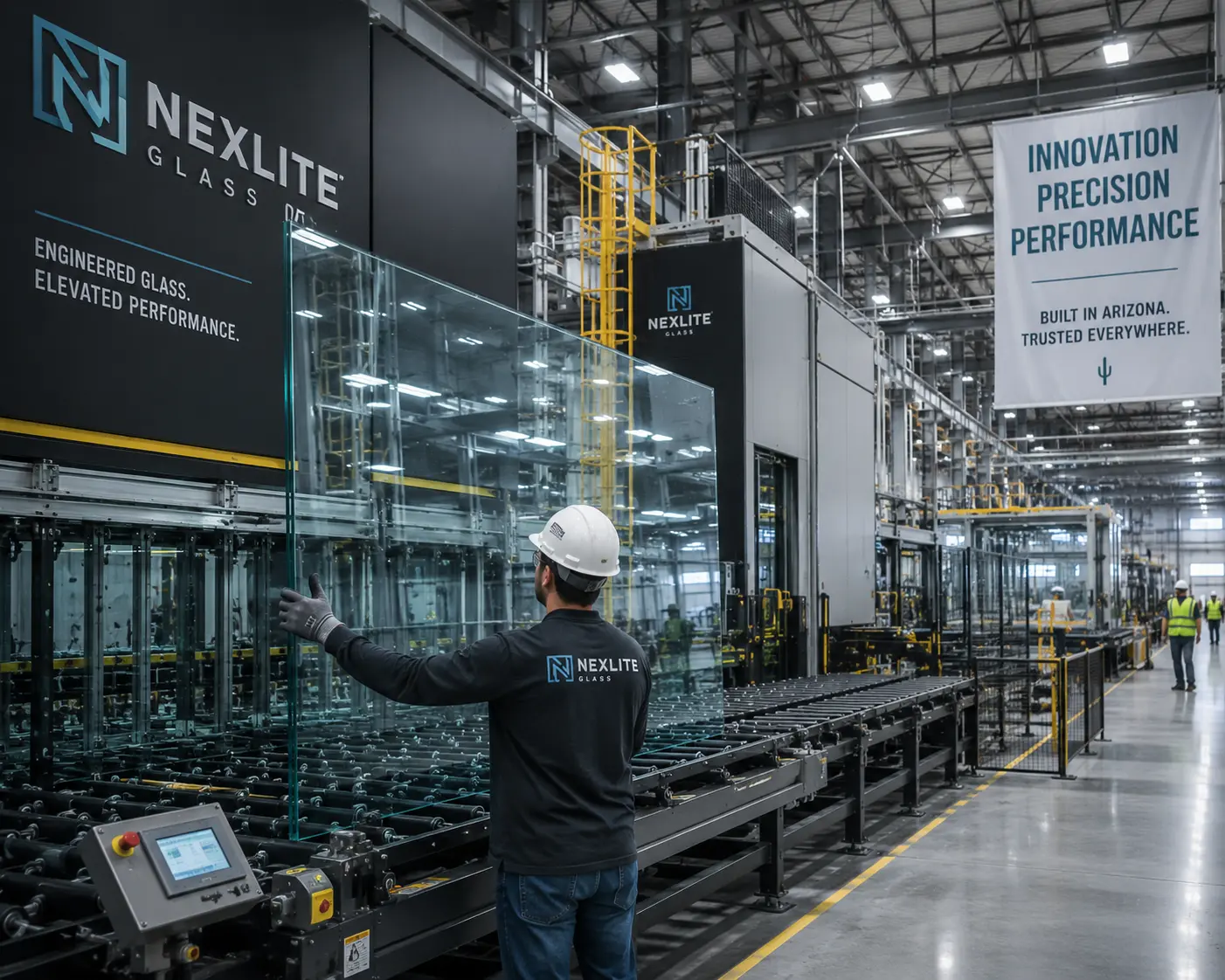
Cardinal Glass Industries has expanded its CLiC on-demand privacy glass to 10.75-foot heights and 50 sq ft panes while opening a new 800,000 sq ft manufacturing facility. For specifiers burned by first-generation PDLC switchable glass, the film-free PSCT alternative changes the conversation.
Switchable privacy glass has been on architects' radar for a decade, but PDLC-based products earned a reputation for haze, slow switching, and failure modes that made specifiers cautious. Cardinal Glass Industries is pushing a different technology path — and a series of announcements this fall suggests the category is finally ready for mainstream spec work.
What Cardinal Just Changed
In its November 2026 product update, Cardinal expanded the dimensional envelope of its CLiC On-Demand Privacy Glass significantly. The glass is now available in custom panes up to 50 square feet, accommodating heights up to 10.75 feet and widths as narrow as 7 inches, with a reduced 9.9 mm thickness that spans the entire size range for greater manufacturing flexibility.
That thickness matters for integration. For exterior applications, overall unit thicknesses range from ¾ inch to 2 inches in both dual- and triple-glazed configurations, making CLiC insulating units compatible with standard residential doors, windows and framing systems without requiring additional modifications.
Translation for product managers: window and door OEMs don't have to redesign their platforms to offer switchable glass as an upgrade option. A standard IGU pocket accepts it.
Why PSCT Matters More Than the Marketing Suggests
The underlying chemistry is the real story. CLiC uses an all-new, film-free PSCT technology to shift from clear to private in milliseconds, and the technology eliminates the haziness and common failure modes associated with older PDLC-based switchable privacy products.
PSCT uses minimal polymer and no internal films; it relies on a cholesteric liquid-crystal helix stabilized by a thin polymer network instead of thick polymer matrices or plastic interlayers. In default mode, the helix scatters light to provide privacy.
That matters for three reasons:
- Durability. PSCT outperforms traditional liquid crystal for durability, resulting in privacy glass that withstands the elements to protect homes and buildings. That's what makes exterior applications credible.
- Clarity. In clear mode, CLiC is designed to show no visible haze, fogging or distortion, even at an angle, and in private mode the glass scatters daylight and still lets it through, so the room stays bright.
- Energy load. CLiC consumes less than one-third of a watt per square foot in clear mode, comparable to a small LED light, and no power at all in privacy mode. For load calculations and smart-building integration, that's negligible.
The Manufacturing Signal
Cardinal backed the product expansion with capital. The company's dedicated privacy glass manufacturing facility now spans more than 800,000 square feet; originally established in 1988 as a 60,000-square-foot overflow site for made-to-stock insulating glass units, it has grown into one of the most advanced and automated glass manufacturing facilities in the world.
Capacity like that changes what a specifier can promise on a schedule. Switchable glass has historically carried long lead times, custom-run economics, and single-source risk. A dedicated, automated plant at this scale moves CLiC closer to a catalog item.
Practical Implications for Specifiers and GCs
For architects:
- CLiC is now a credible alternative to interior blinds, shades, and frosted film on partitions where sightlines and daylight matter. Healthcare and workplace interiors are the obvious targets.
- Exterior use is on the table. Residential ground-floor glazing, pool-facing doors, and street-level storefronts can now be specified with on-demand privacy without compromising the IGU envelope performance.
For GCs and installers:
- Low-voltage wiring coordination becomes part of the glazing scope. Trim this out in the submittal phase, not on punch.
- Because CLiC lives in a standard IGU pocket, replacement and warranty swaps follow familiar insulating-glass workflows rather than custom film-retrofit procedures.
For window and door manufacturers:
- The 9.9 mm monolithic thickness and compatibility with standard frames lowers the barrier to adding switchable glass as a factory option. Cardinal is clearly courting OEM integration, not just one-off commercial specials.
- PDLC-era service horror stories still haunt the category. Manufacturers taking a second look should test clarity, haze, and switching speed side-by-side before updating their option sheets.
The category has had false starts before. What's different in late 2026 is that Cardinal has married a differentiated chemistry to a dedicated high-volume plant and sizes that fit the architectural glass norm. That combination is what finally makes switchable privacy a specification conversation worth having again.